
Construction site CCTV in Belfast usually means either a temporary tower unit or fixed IP cameras on hoardings, cabins or site structures. The right choice depends on programme length, power, camera positions, public-facing boundaries and whether footage needs remote monitoring, remote viewing or recorded evidence for insurers.
Belfast contractors normally ask this question after one of three moments. A theft or damage incident has happened. An insurer, client or neighbour has asked what site-security controls are in place. Or the principal contractor is reviewing construction phase arrangements and wants a clear, documented answer before the next stage of the programme.
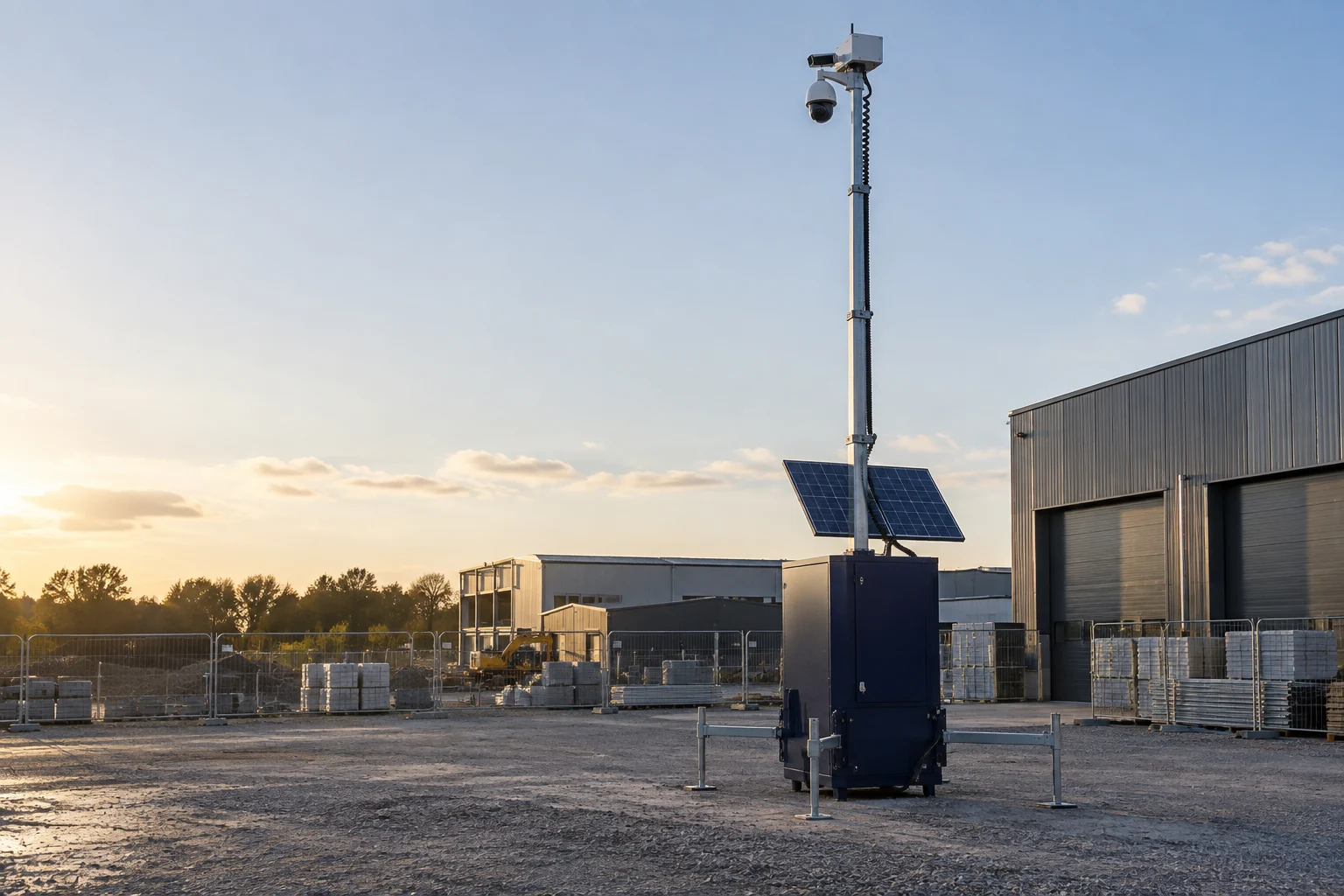
For most short or moving works, a temporary CCTV tower is the practical starting point because it can be redeployed as the site changes. For longer programmes, fixed cameras often make more sense because the same system can protect cabins, stores, entrances, compounds and completed areas. A mixed design is common on phased Belfast projects where the perimeter changes but the site office, welfare unit or materials store stays in one place.
Advanced Overwatch designs construction site CCTV for Belfast and wider Northern Ireland sites from a single Coleraine office, with regional contact numbers for Belfast and other areas. The process starts with a free survey, then a fixed written quote, so the contractor knows what is covered, what is excluded and what the next step costs before approving the work.
How much does construction site CCTV cost in Belfast?
Construction site CCTV cost in Belfast depends on the site layout, programme length, camera count, power availability, network access, monitoring requirement and whether the project needs a tower, fixed cameras or a combined design. A compact refurbishment with one entrance and a cabin is a different job from a city-centre project with hoarding, multiple gates, neighbours, public footpaths and changing work zones.
The main cost drivers are:
- Site size and number of usable camera positions.
- Whether the system needs temporary tower cover, fixed cameras or both.
- Power availability, including whether the location has reliable mains power.
- Connectivity for remote viewing, alerts and evidence retrieval.
- The programme length and whether cameras need to move during the build.
- Whether cameras view workers, public areas, neighbouring property or public roads.
- Documentation requirements for the client, insurer or principal contractor.
The safest way to price the work is a survey first, because a camera plan should follow the actual risks on the site. A cheap quote that misses the gate, compound, fuel store or public-facing boundary can cost more later if footage is not useful. A good survey should identify what needs to be seen, what does not need to be captured, where signage is needed, how footage will be accessed and who the data controller is.
Advanced Overwatch does not need to publish a generic price for a Belfast construction site because the useful answer is a fixed written quote after the free survey. That protects the contractor from vague allowances and makes the proposal easier to compare with other suppliers.
Get a free survey. Free, no obligation. We survey, you decide.
Tower or fixed cameras: which does my Belfast site need?
A Belfast construction site normally needs a CCTV tower when the project is temporary, moving or hard to cable. Fixed cameras are better when the site has stable structures, reliable power and a longer programme. Many projects use both: a tower for the changing works area and fixed cameras for the cabin, gate, stores and completed sections.
| Tower unit | Fixed cameras | |
|---|---|---|
| Best for | Short or moving projects | Long builds, stable cabins, gates and stores |
| Power | Self-contained options may be available, subject to survey | Usually needs a reliable supply |
| Redeployment | Easier to move as the site changes | Usually fixed once installed |
| Coverage style | Broad temporary overview | Designed views of entrances, compounds and high-value areas |
| After completion | Removed when no longer needed | Can sometimes stay as permanent cover |
For a short programme, a tower can make sense because it reduces the need for permanent cabling and can follow the work. For a longer Belfast build, fixed cameras can give more deliberate views of entry points, cabins and material storage, and may become part of the finished premises security system.
The practical test is not “tower or fixed?” in isolation. It is “what evidence would we need if something happened tonight?” If the answer is a clear view of the gate, the compound and the out-of-hours access route, the design should be built around those views first.
Does construction site CCTV satisfy CDM duties in Northern Ireland?
Construction site CCTV does not, by itself, satisfy CDM duties in Northern Ireland. The Construction (Design and Management) Regulations (Northern Ireland) 2016 set duties for managing construction work safely, including arrangements that prevent unauthorised access to the site. CCTV can support those arrangements, but it is not a substitute for gates, hoarding, lighting, supervision, induction, site rules or a written construction phase plan.
The useful role of CCTV is evidence and visibility. Cameras can show whether a gate was opened, whether a person entered a restricted area, whether a delivery arrived, whether a compound was interfered with and what happened out of hours. That can help the principal contractor, client, insurer or facilities team understand whether the site-security plan is working.
For Belfast sites, the wording should stay proportionate. It is safe to say CCTV can support site-security arrangements and help document what is covered. It is not safe to say CCTV is required by CDM, guarantees compliance or replaces the principal contractor’s wider duties.
In our experience, the strongest projects are the ones where the CCTV drawing matches the site plan. If the hoarding line moves, the camera view should be reviewed. If the compound moves, the evidence plan should move with it.
Can I put a CCTV tower on a public road or footpath in Belfast?
A CCTV tower or temporary equipment on a Belfast public road, footpath or verge may need consent or a licence from the roads authority. In Northern Ireland, DfI Roads is the relevant public authority for roads matters. The safe approach is to check the siting during the survey before equipment is placed, especially where the tower, stabilisers, barriers, cables, hoarding, signage or camera position could affect the public highway.
There is an important difference between a private camera that incidentally views a road and equipment physically placed on, fixed to, overhanging or obstructing the public highway. The first issue is mainly about privacy, camera angle and data protection. The second can involve highway permission, public safety and site-management controls.
For Belfast contractors, the survey should ask:
- Will any tower, base, barrier, sign, cable or mounting sit on the footpath or road?
- Could the equipment narrow a pedestrian route or affect visibility?
- Will the camera capture neighbouring premises, homes or public areas?
- Is the system fixed to street furniture, hoarding or a structure owned by someone else?
- Who will hold the permission records if DfI Roads consent is needed?
Advanced Overwatch can advise on the CCTV design, but the contractor or client may still need permissions for public-highway occupation or hoarding arrangements. The proposal should make that responsibility clear.
Is construction site CCTV GDPR compliant?
Construction site CCTV can be UK GDPR compliant when it has a clear purpose, a lawful basis, visible signage, proportionate camera views, access controls, retention rules and a process for subject access requests. The ICO’s video surveillance guidance is the right reference point for UK organisations using CCTV.
For a Belfast building site, the controller is usually the organisation deciding why and how the cameras are used. That might be the contractor, developer, property owner or another party named in the project arrangements. The controller should document the purpose, usually security, safety or asset protection, and should avoid capturing more than necessary.
Good practice includes:
- Signs before people enter the recorded area, showing who controls the system and how to contact them.
- Camera views that avoid neighbouring homes, private gardens and unrelated public areas where possible.
- A retention period based on the reason for recording, not simply on hard-drive capacity.
- No audio recording by default, because audio is usually more intrusive.
- Restricted access to live and recorded footage.
- A documented assessment where cameras capture workers, public areas or higher-risk views.
- A process for handling subject access requests and sharing footage only where there is a lawful reason.
There is no fixed UK GDPR rule that every construction site must keep CCTV for a set number of days. Thirty days is common in many settings, but the lawful period depends on the purpose, risk and operational need.
Can I view my Belfast site cameras remotely?
Yes, construction site cameras can usually be set up for remote viewing on a phone or PC, subject to connectivity, permissions and the system design. Remote viewing is useful because a site manager, contracts manager or business owner can check live and recorded footage without travelling to the site.
The benefit is not just convenience. Remote viewing helps with practical decisions:
- Checking whether a gate is locked after hours.
- Reviewing whether a delivery arrived.
- Seeing whether a cabin, scaffold line, compound or fuel store is still secure.
- Retrieving evidence quickly for an insurer or investigation.
- Checking weather-related issues on exposed sites.
- Reviewing progress without asking someone to make an extra visit.
Remote access must still be controlled. Accounts should be named, permissions should match job roles and access should be removed when staff or contractors leave the project. For sites with multiple companies involved, the controller should decide who is allowed to view footage and why.
What happens next after a Belfast construction site CCTV survey?
The next step should be simple. A Belfast construction site CCTV project should move from survey to fixed quote, then installation, then aftercare. The contractor should not have to decode a vague camera list or guess what is included.
The Advanced Overwatch process is:
- Free survey: We review the site layout, entrances, hoardings, cabins, compound, power, connectivity and public-facing boundaries.
- Fixed quote: We set out the recommended tower, fixed camera or mixed design, with clear scope and assumptions.
- Installation: We install the agreed system, position cameras for useful evidence and confirm remote access where included.
- Aftercare: We help with handover, support, adjustments and any planned changes as the programme moves.
The best time to arrange the survey is before the site layout becomes crowded. Early planning makes power, camera position, signage and privacy easier to handle. If the site has already had an incident, the survey can focus on the immediate gap first, then add longer-term coverage as the project stabilises.
Questions contractors ask
What is the minimum contract length for CCTV tower hire in Belfast?
The minimum contract length should be confirmed in the fixed quote after the survey, because the right term depends on the site programme, equipment type, deployment cost and whether cameras need to move during the works. For a short Belfast project, a tower may be used only for the active high-risk period. For a longer build, a fixed or mixed system may stay in place across phases and then convert into permanent security. The important point is to avoid agreeing a term before the survey has confirmed what the site actually needs.
Does construction site CCTV replace fencing, hoarding or site lighting?
No. Construction site CCTV supports site security, but it does not replace physical controls such as fencing, hoarding, locks, lighting, signage and supervision. Cameras are strongest when they form part of a layered plan: the perimeter slows or prevents access, lighting improves visibility, signage tells people CCTV is in use and recorded footage helps establish what happened. For Belfast sites, this matters most where the project faces a public road, shared boundary, neighbouring premises or out-of-hours access route.
Who is responsible for GDPR on a construction site CCTV system?
The data controller is the organisation that decides why the CCTV is used and how the footage is handled. On a Belfast construction site, that could be the principal contractor, client, developer or another agreed party. The controller should document the purpose, lawful basis, signage, access permissions, retention approach and subject access process. The installer can advise on camera positioning and system controls, but the controller remains responsible for the data protection decisions behind the system.
Does CDM in Northern Ireland require CCTV?
These Northern Ireland regulations set duties for managing health and safety during construction work. CCTV is not named as a mandatory control, but cameras can support a wider plan for preventing unauthorised access and documenting site-security arrangements.
What does UK GDPR mean for construction site CCTV?
UK GDPR governs how personal data is processed, including identifiable people captured on CCTV. For construction sites, it means the controller needs a lawful basis, clear purpose, proportionate camera views, access control and a retention approach that matches the reason for recording.
How does the Data Protection Act 2018 apply to site footage?
This UK law sits alongside UK GDPR and is relevant when CCTV footage identifies living individuals. It supports rights such as subject access and reinforces the need to handle footage lawfully and securely.
What is the ICO video surveillance guidance?
The Information Commissioner’s Office guidance explains how organisations should approach CCTV and other surveillance systems. It covers privacy information, signage, accountability, retention and individual rights.
What is the Roads (Northern Ireland) Order 1993?
This is the main roads legislation behind many DfI Roads controls in Northern Ireland. For CCTV projects, the practical point is that equipment on, over or affecting a public road or footpath may need consent or a licence.
Planning security for a Belfast site?
We survey the site layout, entrances, hoardings, cabins, compound, power and connectivity, then give you a fixed written quote for a tower, fixed cameras or a mixed design, and look after the system as the programme moves.
Related: CCTV tower hire in Belfast, CCTV rental systems and CCTV compliance.
Advanced Overwatch is SSAIB certificated (NIRE127) for intruder alarms, CCTV and access control, and certified to ISO 9001, ISO 14001, ISO 27001 and ISO 45001.