
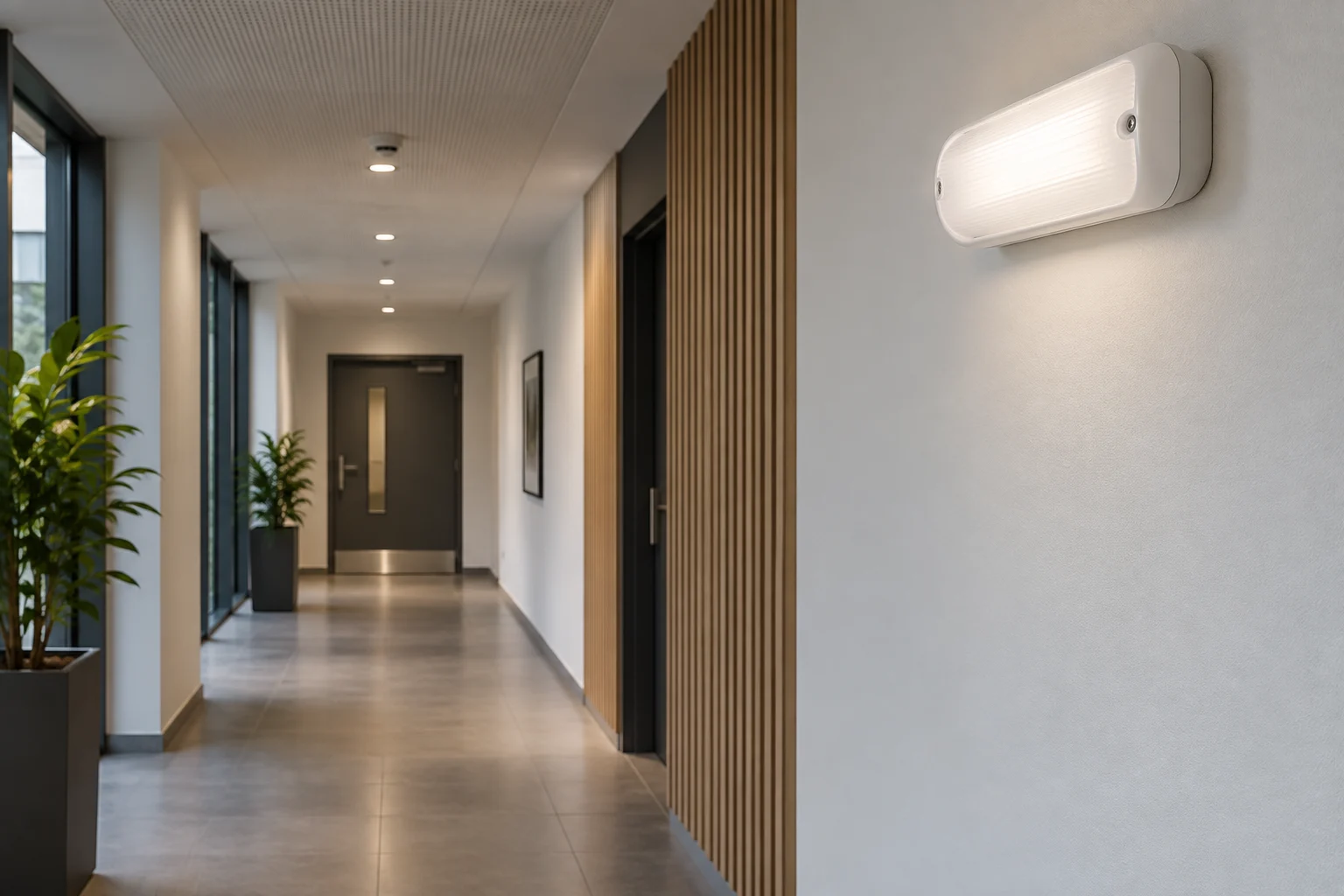
Emergency Light Testing Lurgan and Craigavon
Emergency light testing in Lurgan and Craigavon means a short monthly function test of every luminaire and exit sign, then a yearly test that runs each fitting for its full rated duration. Advanced Overwatch carries out both to BS 5266-1 and BS EN 50172, logs every fitting, repairs what fails and leaves a signed certificate for your fire safety records.
Security for businesses and homes across N.I.
Lurgan and Craigavon
Emergency light testing across Lurgan and Craigavon
Advanced Overwatch tests emergency lighting for businesses across Lurgan, Craigavon and the surrounding Armagh City, Banbridge and Craigavon borough. We work across Northern Ireland and cover the area as a single team, so the engineer who surveys your building is the engineer who comes back for the annual test.
Portadown has its own page. If your premises sit on that side of the Bann, start with emergency lighting in Portadown instead of this one.
Lurgan and Craigavon sit either side of the M1 corridor and the building stock reflects it. There is distribution and manufacturing space at Silverwood Business Park and along the Silverwood Road, retail floorspace at Rushmere and through Lurgan town centre, offices and public buildings around Central Way, and older terraced commercial property on Market Street and High Street. Those four building types fail their emergency lighting in four different ways, which is why the survey comes before the quote.
Warehousing
High bay warehouses change how the annual test is planned
Silverwood and the units near Junction 10 of the M1 include a lot of high bay distribution space, and high bay changes three things about a test.
Access.
Fittings sit above racking that is usually full. A luminaire needing a battery change is a lift job rather than a step ladder job, so access and timing are agreed before the visit instead of being discovered on the day.
Racking moves.
A warehouse that reconfigures its racking has changed its escape routes and its sightlines, and lighting designed for the old layout may now be blocked. We record where the racking stands at the time of the test, so any change shows up in the next report.
Recharge time.
The annual test flattens the batteries and they need to recharge before the fittings give full protection again. On a site running shifts we book the discharge into a planned quiet window and agree what cover applies while the batteries recover.
Retail has the opposite problem. Rushmere and the Lurgan town centre units have short trading gaps, a lot of luminaires and public circulation space that cannot be left unlit, so those are usually tested outside opening hours.
The two tests
The two tests, and why the monthly one is not enough
Emergency lighting in Craigavon is designed to the BS 5266-1 code of practice. The current edition is BS 5266-1:2025, published on 29 October 2025 in place of the 2016 edition. The testing and documentation side sits in BS EN 50172:2024, the standard for emergency escape lighting systems.
- The monthly function test. The normal lighting supply is interrupted briefly and every luminaire and exit sign is checked to confirm it lights, is clean and is not obstructed. It is short, and on many Lurgan and Craigavon sites a member of your own staff can be shown how to run and record it.
- The annual duration test. Each fitting runs on battery for its full rated duration, commonly three hours in a commercial building, and is checked again at the end. This is the test a tired battery fails.
A fitting can pass twelve monthly tests and still go dark in November. A brief flick proves the lamp and the changeover work and says nothing about how long the battery will hold. Closing that gap is the whole point of the annual test. Our guide explains why the annual duration test cannot be skipped and how long the batteries need to recharge afterwards.
Book an emergency lighting survey in Lurgan or Craigavon
A free survey of your premises, a count of every luminaire and exit sign, then one fixed quote for the testing programme. Call us and speak to an engineer.
What Northern Ireland law asks of you
The legal duty
The duty holder here is not called the responsible person, as it is in England and Wales. In Northern Ireland it is the person with duties under Article 25 or Article 26 of the Fire and Rescue Services (Northern Ireland) Order 2006: the employer, and anyone who has control of the premises to any extent. That is the person an inspector asks for the emergency lighting records.
Regulation 13(2)(h) of the Fire Safety Regulations (Northern Ireland) 2010 requires that emergency routes and exits needing illumination are provided with emergency lighting of adequate intensity for a failure of the normal lighting. Regulation 16 then requires equipment provided under those regulations to be kept under a suitable system of maintenance, in efficient working order and in good repair. Testing, recorded properly, is how the second duty is evidenced.
What we hand over after the annual test
Paperwork
Every visit ends with paperwork you can put in front of an inspector or an insurer.
- A schedule of every luminaire and exit sign by location, type and rated duration.
- The result for each fitting, with failures identified by position rather than buried in a total.
- What was repaired on the day, and what is outstanding with a recommendation.
- A signed certificate and an entry for your fire safety log book.
Engineers carry common batteries, lamps and gear trays, so most failures are put right on the same visit. Where a fitting has reached the end of its life we quote separately for replacement. Testing itself is a fixed quote after a free survey, because the only honest way to price it is to count the fittings and look at how they are reached.
Qualified, audited and independent
Emergency lighting is designed, installed and tested by qualified engineers to the British Standards, with commissioning and test documentation issued every visit. One Coleraine team, no franchise and no call centre.
- Est. 2017
- Tested to BS 5266-1 and BS EN 50172
- Qualified engineers, documented commissioning
- ISO 9001
- ISO 14001
- ISO 27001
- ISO 45001
Emergency light testing in Lurgan and Craigavon, your questions
How often does emergency lighting need testing in Lurgan and Craigavon?
A short function test every month and a full rated duration test once a year, in line with BS 5266-1 and BS EN 50172, and both need to be recorded. We can run both, or run the annual test and show your own staff how to carry out and log the monthly one.
Do you cover Portadown from this page?
Portadown is covered, but it has its own page with detail specific to the town. See emergency lighting in Portadown. This page is for premises in Lurgan, Craigavon and the surrounding area.
How much does emergency light testing cost?
It depends on how many luminaires you have and how they are reached, which is why we do not publish a rate. You get a fixed quote after a free survey, and the figure quoted is the figure you pay.
Can a warehouse be tested without stopping work?
Usually. The monthly function test is short. The annual duration test flattens the batteries for their full rated period, so on a shift site we plan it into a quiet window and agree in advance what applies while the batteries recharge.
Is emergency lighting work certified?
Emergency lighting is installed and tested by qualified engineers to BS 5266-1 and BS EN 50172, with commissioning and test documentation issued every visit. Advanced Overwatch also holds ISO 9001, ISO 14001, ISO 27001 and ISO 45001 certification, which covers how the work is managed and recorded.
Where else we test emergency lighting
Emergency lighting beyond Lurgan and Craigavon
The same testing programme runs across Northern Ireland. Start with the emergency lighting service page, or go straight to a neighbouring town.
The other town pages in the same testing series are Newtownards, Enniskillen, Carrickfergus, Castlereagh and Larne.
Get your Lurgan or Craigavon emergency lighting tested
Book a free survey and we will count the fittings, look at how they are reached and give you one fixed quote for the testing programme.