
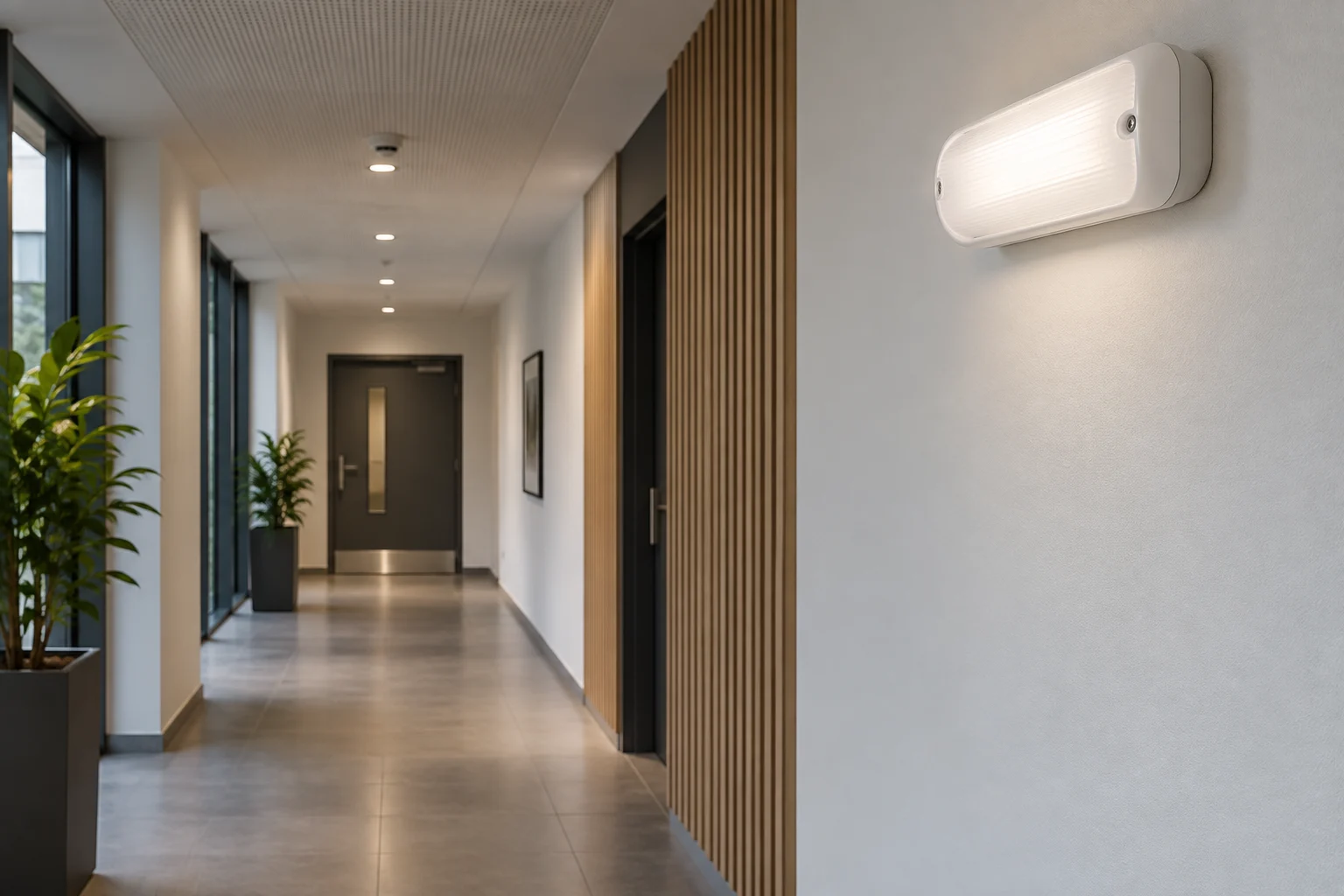
Emergency Light Testing in Armagh
Emergency lighting testing across Armagh and Mid-Ulster, carried out by qualified engineers, with full documentation and any remedial work handled, from a Northern Ireland team that covers the whole area.
Security for businesses and homes across N.I.
Emergency Light Testing
Emergency Light Testing Armagh
Emergency lighting must be tested at regular intervals under BS 5266-1:2025, this is not optional maintenance, it is a legal requirement for virtually every non-domestic building in Northern Ireland. Advanced Overwatch provide BS 5266-1 compliant emergency light testing across Armagh, Portadown, Lurgan, Craigavon, Dungannon, and the wider Mid-Ulster area. Our local engineers carry out monthly function tests and the full annual discharge test required by BS 5266-1, issuing compliance certificates and written reports after every visit.
The same testing programme runs in Lurgan and Craigavon, Newtownards, Enniskillen, Carrickfergus, Castlereagh and Larne, and the full emergency lighting design and installation service covers new systems as well as testing.
If you manage a commercial premises, school, warehouse, retail unit, or licensed venue in Armagh and need a local contractor to handle your emergency lighting compliance, call us on 028 7087 8077 or request a free survey on our contact page.
What Our Emergency Light Testing Covers
Advanced Overwatch carries out the routine emergency lighting tests required in commercial premises across Armagh. Those tests are:
- Monthly function test, a brief activation to confirm each fitting illuminates and exit signs are visible. In a small premises it takes a few minutes, long enough to walk the escape routes and see every fitting and exit sign lit.
- Annual full-duration test, each fitting is discharged for its full rated duration (1 hour or 3 hours depending on the fitting). The most thorough test; reveals degraded batteries that shorter tests miss.
After every annual test we issue a written report and a compliance certificate. We maintain a site logbook record for every client.
Our Testing Process
Site visit and visual inspection
check fittings for physical damage, blocked sightlines, and adequate coverage of escape routes.
Load test activation
fittings are activated in sequence to the required duration for the test being carried out.
Fault identification and logging
any fitting that fails to reach rated duration or fails to illuminate is logged with location, fitting type, and fault description.
On-site rectification
our engineers carry common replacement batteries and lamp units. Most faults are rectified on the day.
Report and certification
a written inspection report and compliance certificate are issued before we leave site.
Types of Emergency Lighting We Test
Advanced Overwatch tests every standard emergency lighting configuration found in Armagh commercial premises. The configurations covered are:
- Non-maintained fittings, activate only when mains power fails; the most common type in offices and warehouses.
- Maintained fittings, remain illuminated continuously; required in licensed venues, cinemas, and similar premises under fire risk assessment direction.
- Central battery systems, a single battery bank feeds multiple fittings; common in larger commercial buildings and schools.
- Exit signs and escape route luminaires are tested as part of the same programme.
Why Choose Advanced Overwatch in Armagh
Local engineers
no national contractor call centre, no long lead times. Engineers travel across Northern Ireland and cover Armagh and mid Ulster.
Same-day certification
compliance certificate issued on completion of the annual test, not posted later.
Replacement parts on the van
most faults are rectified during the same visit, avoiding a return trip and compliance gap.
ISO 9001 certified quality management
our testing procedures and documentation meet the same quality standard as our installation work.
Combined service contracts
if your premises also has an intruder alarm, CCTV, or access control system, a single maintenance contract covering all systems reduces your administration and call-out costs.
For a free survey and quote, call 028 7087 8077 or visit our contact page.
Advanced Overwatch is SSAIB certificated (NIRE127) specifically for Intruder Alarm Systems, Visual Surveillance Systems (VSS) and Access Control Systems. That certification does not cover fire alarm work or emergency lighting, which we carry out to BS 5266 with qualified engineers. ISO 9001, 14001, 27001, 45001 Certified.
Why Emergency Lighting Testing Is a Legal Requirement
The Fire and Rescue Services (Northern Ireland) Order 2006 places a clear duty on the “appropriate person”, the building owner, employer, or facilities manager, to maintain all fire safety systems in working order. Emergency lighting is explicitly included.
BS 5266-1:2025, the British Standard for emergency lighting, specifies the testing intervals and record-keeping requirements that satisfy this duty. A business that cannot produce a logbook of tests and a current compliance certificate is exposed to enforcement action from the Northern Ireland Fire and Rescue Service, potential insurance voidance, and personal liability for the appropriate person.
Testing is not a box-ticking exercise. Fittings that pass a monthly function test can still fail an annual full-duration discharge because the battery has degraded. Only a programme of both routine tests catches the full range of failure modes. For the current test intervals and record keeping rules, including which edition of BS 5266-1 applies now, see our emergency lighting guide.
Accredited, audited & independent
Independently certified and answerable only to our customers, no franchise, no head-office script, one local Coleraine team.
- Est. 2017
- ISO 9001
- ISO 14001
- ISO 27001
- ISO 45001
Advanced Overwatch is SSAIB certificated (NIRE127) specifically for Intruder Alarm Systems, Visual Surveillance Systems (VSS) and Access Control Systems. This certification does not cover emergency lighting.
Frequently Asked Questions
How often does emergency lighting have to be tested in an Armagh commercial building?
BS 5266-1:2025 sets two routine tests. A monthly function test confirms every fitting illuminates when the mains supply is interrupted. An annual test discharges every fitting for its full rated duration, usually one or three hours. We carry out both across Armagh and record the results for your logbook.
Do you test emergency lighting in Portadown, Lurgan, Craigavon and Dungannon?
Yes. The same engineers cover Armagh, Portadown, Lurgan, Craigavon, Dungannon and the wider Mid Ulster area, travelling across Northern Ireland. Testing is scheduled around your opening hours, and where a site has several buildings we work through them in one visit so you receive a single set of certificates rather than separate paperwork for each block.
How do I test emergency lighting without a key switch?
Most installations are tested from a key switch or a designated test breaker. Where neither is fitted, the lighting circuit has to be isolated safely at the distribution board, which is work for a qualified electrician rather than site staff. Self testing fittings run their own function and duration tests and flag faults on the fitting or at a panel. We confirm which arrangement your building has on the first visit.
What paperwork do I get after a test?
After every annual test we issue a written inspection report and a compliance certificate before leaving site, and we keep a logbook record for the premises. The report lists any fitting that failed to illuminate or to reach its rated duration, with its location, fitting type and the fault found, so you can show an inspector or an insurer a full history rather than a bare pass.
What happens if a fitting fails the annual discharge test?
It is logged with its location, fitting type and fault description, then rectified on the day wherever possible, because our engineers carry common replacement batteries and lamp units. Anything that needs a part we do not hold is quoted separately, with a fixed quote after a free survey where the remedial work is larger. The replacement is then retested to confirm it reaches its rated duration.
Is emergency light testing a legal requirement in Northern Ireland?
In practice, yes. The Fire and Rescue Services (Northern Ireland) Order 2006 places a duty on the appropriate person, usually the owner, employer or facilities manager, to keep fire safety systems in working order, and emergency lighting is included. BS 5266-1:2025 sets out the testing intervals and records that satisfy that duty, and it is usually the missing logbook that enforcement action turns on.
Advanced Overwatch
Keep your emergency lighting compliant
Book an emergency lighting test for your Armagh premises, full documentation, honest advice and any remedial work handled by one local team.