Planned servicing visits
Scheduled inspections and testing to current standards, timed around your premises and its use.

More Home Security
Monitoring & Response
Home CCTV, alarms and safes designed, installed and monitored by one local SSAIB Certified team.
Book a Free SurveyMonitoring & Maintenance
Consultancy & Compliance
Business Technology
24/7 Support
North Coast & West
Greater Belfast & East
South & Mid Ulster
Explore
CCTV Tower Hire
We install and monitor across all of Northern Ireland. Tell us where you are and we will book a free survey.
Book a Free Survey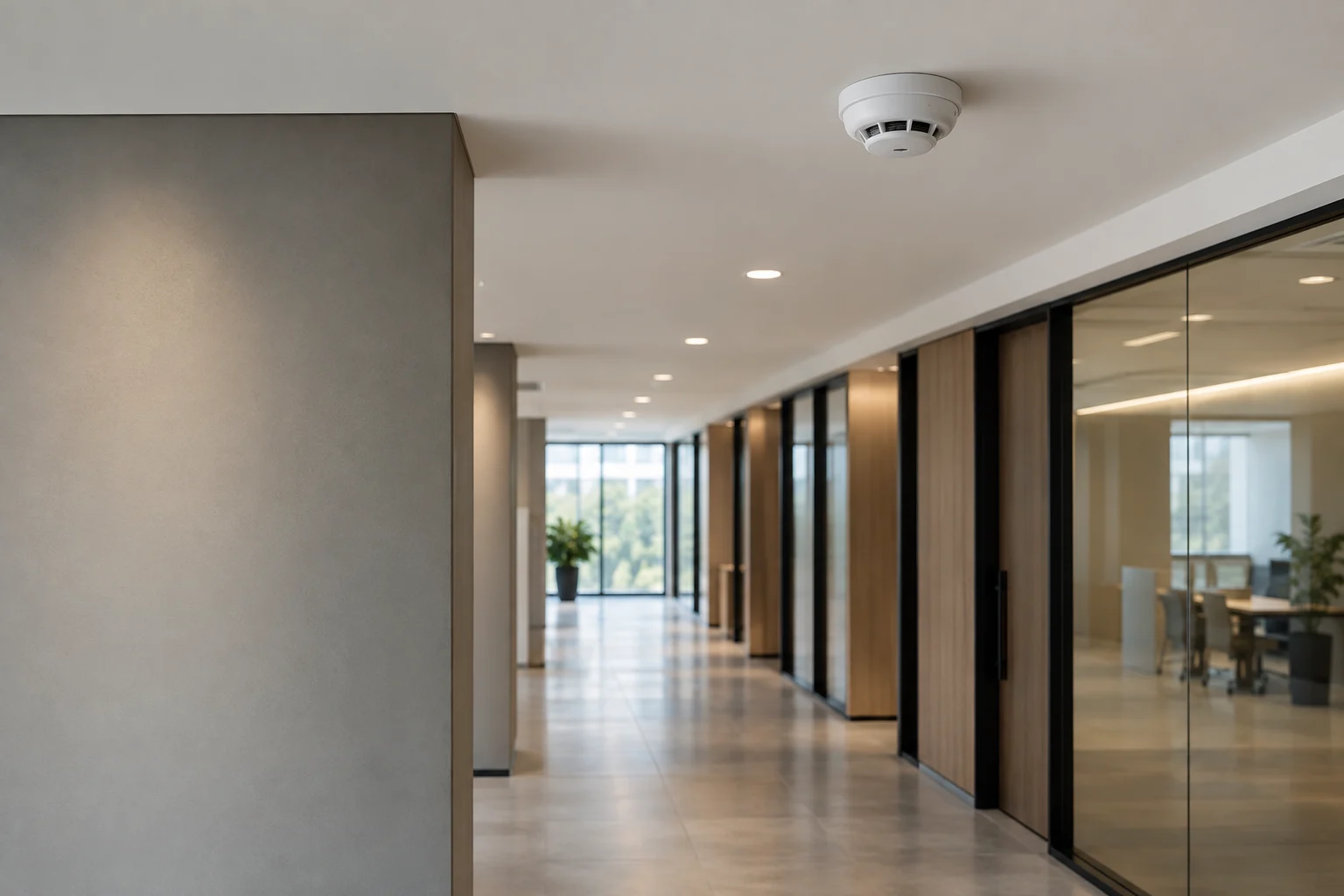
Advanced Overwatch services and maintains fire alarm systems to BS 5839-1 for premises across Northern Ireland.
A fire alarm only protects you if it works on the day. We service and maintain fire alarm systems to current standards, with planned inspections, honest fault reporting and the paperwork your inspections require. Need a new system? See fire alarm installation.
Security for businesses and homes across N.I.
Condition survey. On a system we have not seen before we establish what is installed, what category it was designed to, what works and what has been disabled.
Planned visits. Servicing is scheduled around the routine set out in BS 5839-1, which recommends periodic inspection and servicing at intervals not exceeding six months for most premises, alongside weekly user testing carried out by your own staff.
On the visit. Panel and batteries checked, a proportion of devices tested in rotation so every device is covered across the cycle, sounders and interfaces proved, and faults logged with their cause investigated rather than silenced.
Reporting. You get a service record and a written list of anything outstanding, with a recommendation and a price against each.
Between visits. Faults are diagnosed and repaired, and the logbook is kept ready for an inspection at any time.
Planned, documented care for the system your premises depends on.
Scheduled inspections and testing to current standards, timed around your premises and its use.
Faults diagnosed and repaired with clear reporting, so problems are fixed rather than silenced.
Service records and certificates maintained so your logbook stands up to inspection.
If you employ anyone, or you have control over non domestic premises in Northern Ireland, fire safety duties apply to you. Where a fire detection and alarm system forms part of the fire precautions in your risk assessment, keeping it in working order is part of that duty rather than an optional extra.
In practice, the premises that need a planned contract are the ones where nobody would notice a quiet fault: schools and colleges, care and residential settings, hotels and licensed premises, factories and warehouses, offices with several tenants, and community and church halls used by the public.
Landlords and managing agents carry the duty for common areas even where tenants look after their own units, which is where responsibility is most often assumed to sit with somebody else. If your building has a panel and nobody can say when it was last tested, that is the point to start.
Two things sit behind a servicing contract in Northern Ireland. The legal duty comes from Articles 25 and 26 of the Fire and Rescue Services (Northern Ireland) Order 2006 together with the Fire Safety Regulations (Northern Ireland) 2010. Regulation 12 requires premises to be equipped, where necessary, with appropriate means for giving warning in the event of fire, and Regulation 16 requires the facilities and equipment provided to be subject to a suitable system of maintenance and kept in efficient working order and in good repair. The technical standard is BS 5839-1 from BSI, the code of practice for non domestic premises. BS 5839-6 covers domestic premises.
Worth asking any supplier: what category the system was designed to and whether that still matches how the building is used; how many devices are tested on each visit; whether a written report is left on the day; how out of hours faults are handled; and what the contract price includes.
Current standards recommend servicing at least every six months for most premises, with weekly user testing in between. We set a schedule that fits your building and its risk.
Yes. We take over servicing of existing systems regardless of installer, starting with an honest condition survey.
A logbook of tests, faults and services. We maintain the paperwork with every visit so it is always inspection-ready.
Repeated false alarms usually have a findable cause: detector siting, contamination or wiring. We diagnose and fix the cause rather than just resetting the panel.
Yes, we design and install fire alarm systems as well. If your current system is beyond economic repair we will say so plainly.
The law requires equipment provided for fire safety to be kept in efficient working order. BS 5839-1 turns that into a routine, and weekly testing of a manual call point by the responsible person is part of it, using a different call point each week and writing the result in the logbook. Weekly testing does not replace the periodic service visit, and the service visit does not replace it.
There is no blanket rule that every commercial building must have a panel and detectors. The fire risk assessment decides. Where it shows people would not be warned in time without automatic detection, a system becomes part of the fire precautions and then has to be maintained.
Yes. We start with a condition survey to establish what is installed, what category it was designed to and what has been disabled, then quote for putting it right and for the ongoing service. Where a system is beyond economic repair we say so rather than selling a contract on it.
Book a service visit or a free condition survey and we will tell you honestly where your system stands.
What happens next: book a service visit or a free condition survey. We will tell you plainly where the system stands and give you a fixed quote after a free survey.
Established in 2017 and certified to ISO 9001, ISO 14001, ISO 27001 and ISO 45001, we work from our own base at Beresford House in Coleraine. Fire alarm servicing and maintenance is carried out by qualified engineers to BS 5839-1, with a written record left on site after every visit.
Give us a call
Office Hours 9am to 5.30pm, Monday to Friday. 24-hour support priority is given to existing customers.
Send us a message
Chat to our team via WhatsApp.
Send us an email
Email our team directly, view our contact information, and get directions to our offices.
Need Technical Support - visit our 24/7 Support & Resources Hub