
The right construction site CCTV in Armagh combines a rapid-deployment tower for the early ground-works phase, fixed cameras as the building takes shape, and a monitored connection to an Alarm Receiving Centre that verifies and escalates alarms out of hours. For most sites in Armagh and across Mid Ulster, that mix delivers the deterrent insurers expect, the evidence quality police need, and a hand-over path so the same cameras protect the finished building.
This guide walks principal contractors, site managers, and developers through the practical decisions: when to use a tower versus a fixed install, what insurance and CDM 2015 require, how monitoring works, and how to plan a temporary system that becomes the permanent one at handover. It is written from inside the trade by an SSAIB certificated Northern Ireland installer that has wired sites from the Armagh ring road to Newry quayside.
Why construction sites in Armagh need dedicated CCTV
Construction sites are open, valuable, and predictable. Plant, copper cable, fuel, and fit-out materials move on and off site every day, often without a fixed perimeter. Insurers across Northern Ireland have tightened their position on plant theft and fuel loss in recent years, and most commercial policies now ask explicit questions about CCTV cover, monitoring hours, and whether the installer is third-party certified. Armagh sits in a rural belt that includes Markethill, Tandragee, and Keady, with quick access to the M1 and the A1 toward Newry. That road network is a benefit for delivery logistics, but it is the same network that lets a stolen excavator be in the Republic before the morning shift arrives. A camera that records but does nothing is no longer enough. The system has to detect, verify, and trigger a response. There is also a regulatory layer. The Construction (Design and Management) Regulations 2015 (CDM 2015) put the principal contractor on the hook for planning and managing site security, not only welfare and safety. CCTV is one of the most common ways a principal contractor evidences that duty.
The three CCTV setups Armagh sites usually choose
Most sites in the area pick one of three configurations. Picking the right one depends on build duration, the value of plant on site, and whether the system needs to survive into the finished building.
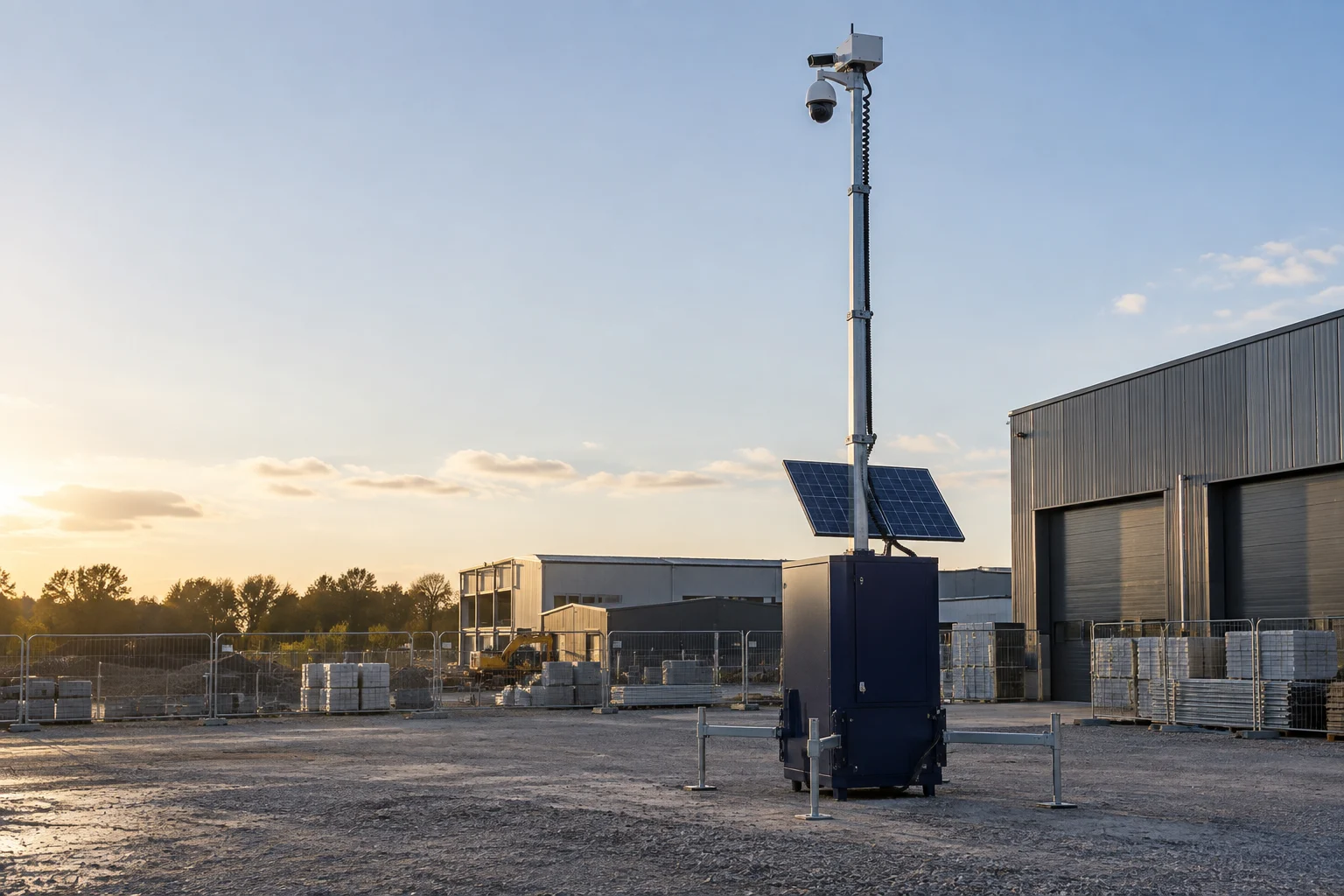
1. Rapid-deployment CCTV towers.Self-contained 4 to 6 metre masts with solar and battery power, 4G connectivity, and one to four cameras per unit. Ideal for week one to first-fix where there is no mains power, no cabin, and no fence-line yet. Towers can be on the ground at first light and operational by lunchtime.
2. Fixed cameras on temporary infrastructure.Once welfare cabins, hoarding, and a temporary supply are in, fixed cameras can be mounted on the cabin, the hoarding, or on lighting columns. They give better image quality at distance, more cameras per recorder, and a steadier connection. They suit medium-build projects of three months or longer.
3. Hybrid temporary-to-permanent.A tower covers the early ground-works, then fixed cameras are installed in line with first-fix electrics. The same recorder, switch, and head-end carry through to handover so the client only pays once for the core kit and once for integration. This works particularly well for new commercial builds in Portadown, Lurgan, and the wider Armagh, Banbridge and Craigavon council area where the building will keep CCTV after occupation.
Monitoring: what BS 8418 actually requires
A camera that records to a hard drive is useful for post-incident investigation. A camera connected to a UK-based Alarm Receiving Centre (ARC) is what stops the incident in progress. BS 8418 is the British Standard that defines this monitored CCTV setup. In plain language, BS 8418 says: the camera must detect an event, the footage must reach the ARC reliably, an operator must verify that the activation is genuine, and the operator must follow a documented escalation. That escalation can be a phone call to the keyholder, a guarding company callout, or, where the system has a Unique Reference Number with PSNI, a police response. A few practical points for Armagh sites:
- Insurers will often ask for BS 8418 monitored CCTV by name on a site over a certain plant value. Get the wording in advance from your broker.
- Police response is not automatic. PSNI URN policy applies and verification requirements have to be met before a URN is issued. Treat police response as a possibility, not a guarantee.
- Solar towers can lose connectivity if the mast is sited in a heavy tree line. The site survey should plan for line of sight to a 4G mast at Loughgall or Hamiltonsbawn before the tower lands.
Insurance, CDM 2015, and contractor access
Three things sit on the principal contractor’s desk on every Armagh build, and CCTV touches all of them.
Insurance.Most policies tie premium reductions and excess levels to whether CCTV is installed, monitored, and certified. The wording will usually reference an SSAIB certificated or equivalent third-party-inspected installer. Send the certification number and the system spec to your insurer in writing before site mobilisation.
CDM 2015.Site security is part of the principal contractor’s duty under regulation 13. Your construction phase plan should reference the CCTV system, the monitoring arrangement, and how cameras avoid recording neighbouring private space. A documented system makes a Health and Safety Executive for Northern Ireland (HSENI) inspection straightforward.
Contractor access.On busier sites in Portadown and Newry, CCTV can be paired with access control on the welfare cabin or main gate. Cards or fobs replace a sign-in book, the recorder timestamps every entry and exit, and disputes about hours, deliveries, or near-misses become reviewable rather than argued.
Areas we cover around Armagh
Advanced Overwatch installs and maintains construction site CCTV across Armagh city, Portadown, Lurgan, Tandragee, Markethill, Keady, Newry, Banbridge, Dungannon, and the wider Mid Ulster and Craigavon council areas. Engineers are dispatched from Coleraine and respond on a documented call-out window. Rural sites toward Crossmaglen and Forkhill are covered, although connectivity surveys take an extra day in those areas because of 4G coverage variation.
Camera and recorder choices that hold up on a building site
Construction sites are punishing on equipment. Diesel exhaust coats lenses, vibration loosens fixings, and ground conditions change weekly. The right hardware has to work in February rain at Cathedral Road and in August dust at the same address. Most AO construction installs use Hikvision or Dahua cameras with infrared illumination and IP67-rated weatherproof housings. For perimeter coverage at distance, varifocal bullet cameras at 4K resolution give an identifiable face at 20 metres in good light and a usable plate read in 4G transmission conditions. Inside hoarding, lower-resolution turret cameras at 4MP cover entry points, welfare cabins, and material stores without overwhelming the recorder bandwidth. Where light pollution is a concern, for example on builds bordering residential streets in Lurgan or Banbridge, AO specifies cameras with smart infrared that adapt the IR power to the subject distance. This avoids the floodlight glow that often draws complaints from neighbours and breaches a site’s noise and light condition under planning. The recorder, or NVR, normally sits inside a hardened cabinet in the welfare unit or the temporary office, with battery backup sized for at least four hours of mains loss. On towers, the recorder is integrated into the mast and protected behind tamper-detection. Two design points matter for evidence quality: footage must be timestamped with a network time reference, and export procedures must be documented so the chain of custody survives if footage is later requested by PSNI or by the insurer’s loss adjuster. Network coverage in Mid Ulster varies. Towers at Loughgall, Hamiltonsbawn, and Tassagh usually have a workable EE or Three signal, but towers near Slieve Gullion or Forkhill often need a dedicated 4G antenna or a bonded multi-network router. The site survey identifies the right answer before the kit lands rather than discovering it after install.
From site survey to handover: a four-stage process
A typical Armagh project runs as follows.
- Site survey. A free survey, arranged across Northern Ireland at a date and time that suits the site. The engineer maps coverage zones, signal lines, lighting, and any cable routes that will exist later in the build.
- Design and quote. A documented system specification, monitoring scope, and insurer-ready certification reference.
- Install. Tower drop within 3 to 5 working days; fixed install in 7 to 14 working days with first-fix coordination.
- Monitoring activation and handover. ARC monitoring active before the first contractor arrives. At project end, the system either de-mobilises or transitions to permanent cover under a maintenance agreement.
Throughout, the installation, the engineering team, and the maintenance procedures sit under Advanced Overwatch’s ISO 9001, ISO 14001, ISO 27001, and ISO 45001 management systems.
Book a free site survey
If you are pricing a build in Armagh, Portadown, Lurgan, or anywhere in Mid Ulster and need CCTV that satisfies your insurer, your principal designer, and your insurer’s CDM auditor, book a free site survey with Advanced Overwatch. Visit
our contact pageor call our team on 028 7087 8077 and ask for the construction site survey desk. Advanced Overwatch is SSAIB certificated (NIRE127) specifically for Intruder Alarm Systems, Visual Surveillance Systems (VSS) and Access Control Systems. Our management systems are certified to ISO 9001, ISO 14001, ISO 27001 and ISO 45001.
Related Questions
How much does construction site CCTV cost in Armagh?
Pricing varies with the duration of the build, the number of cameras, and whether the system is monitored. A single rapid-deployment tower for a groundworks programme is usually quoted as a monthly hire that includes monitoring, while a hybrid temporary-to-permanent install across a multi-phase Mid Ulster commercial build usually moves to a project-priced model. Cost is also affected by 4G connectivity at site, whether mains power is available later in the build, and the value of plant the insurer wants covered. Always ask for a fixed-fee quote tied to the construction programme, not an open-ended monthly rate, and confirm the SSAIB certification number on the quote so the insurer can verify it.
Do I still need a security guard if I have monitored CCTV?
In most cases, no. A BS 8418 monitored system is designed to replace static guarding for out-of-hours cover on construction sites. The ARC operator verifies activations, plays an audio warning if the tower has speakers, and escalates to police or a keyholder under a documented procedure. Manned guarding is still useful where the contract requires a person on the gate during deliveries, where the site is unusually large, or where the build is in a high-incident area and the insurer specifies it. AO does not provide guarding as a service. We integrate our CCTV with a guarding partner where a contract requires both, and we keep the guarding scope distinct from the CCTV scope on paperwork.
Can footage be used as evidence if there is a theft?
Yes, provided the system has been installed and operated in line with the ICO surveillance code and UK GDPR. Cameras must be signposted, footage must be stored securely with controlled access, and the retention period must be defined and enforced. PSNI and commercial insurers will both ask for the chain of custody on any clip used as evidence. AO recorders log every footage export with operator, time, and reason, which is the audit trail that holds up under scrutiny. Plan signage and retention at design stage rather than after an incident, because retrofitting compliance once footage has already been recorded is not always possible.
Standards Explained
The British Standard for monitored CCTV. It sets out how a camera should detect an event, how that event reaches an Alarm Receiving Centre, how the operator verifies the alarm, and how the response is escalated. Insurers reference BS 8418 by name when a construction site requires monitored cover.
CDM 2015 (The Construction Design and Management Regulations 2015).The regulations that govern health, safety, and security planning on construction sites in Northern Ireland. Regulation 13 places the duty on the principal contractor to plan and manage site security, which is where CCTV documentation lives in the construction phase plan.
UK GDPR and the Data Protection Act 2018.The legal framework that governs how a construction site captures, stores, and erases CCTV footage that includes identifiable people. The site is the data controller for footage taken on its land, even when the system is installed and monitored by a third party.
ICO Code on Video Surveillance.The Information Commissioner’s Office guidance that interprets UK GDPR for CCTV. It covers signage, retention, footage access requests, and proportionality. Following the ICO code is the practical route to defensible CCTV on a building site.
SSAIB (Security Systems and Alarms Inspection Board).The UKAS-accredited certification body for security installers in the UK. AO is SSAIB certificated under registration number NIRE127, which is the third-party verification most insurers ask for on a construction site CCTV quotation.
ISO 9001, 14001, 27001, 45001.The four management system standards under which Advanced Overwatch operates: quality (9001), environment (14001), information security (27001), and occupational health and safety (45001). Together they document how the company designs, installs, and maintains construction CCTV consistently and to audit standard.