
Fire Alarm Installation Larne
Advanced Overwatch designs, installs, services and maintains BS 5839-1:2025 fire alarm systems for businesses, hotels, industrial premises and homes in Larne, on Islandmagee and along the Antrim coast. We have been installing life-safety and security systems across Northern Ireland since 2017, and every quote follows a free site survey.
Get my free survey. Call 028 9099 3566. Free, no obligation. We survey, you decide. Thousands of premises secured since 2017.
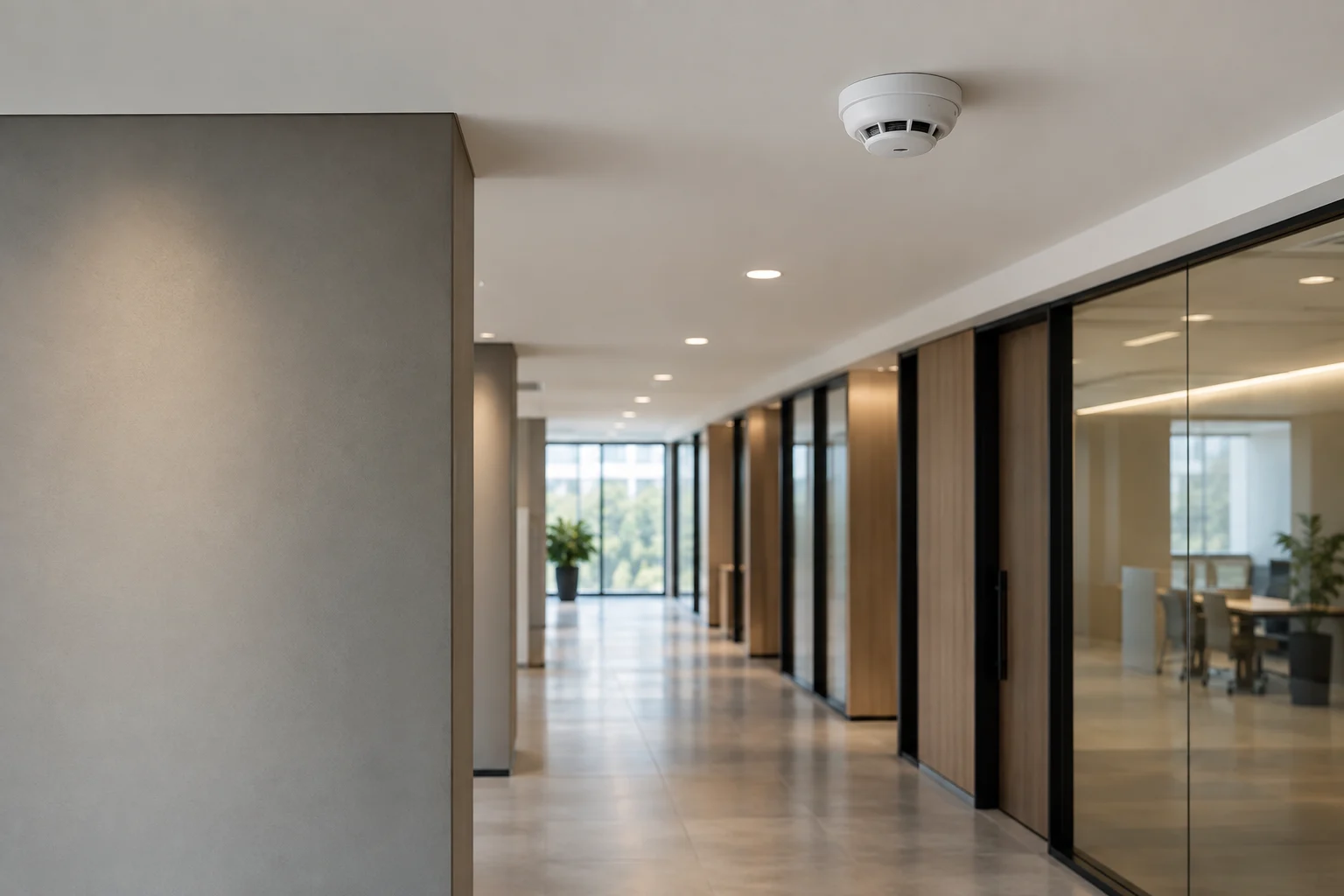
Fire Risk in Larne Runs on a 24-Hour Clock
Larne is a working port town of 18,853 people at the 2021 census, nineteen miles up the coast from Belfast on the A8. It is a roll-on roll-off passenger and freight port with sailings to Cairnryan, and that single fact changes how fire detection has to be designed here.
In most towns, commercial premises empty out in the evening. A great deal of Larne does not. Haulage, storage, distribution and engineering premises around the town work through the night to meet sailings, which means people, vehicles, heat sources and electrical load are present at hours when a building elsewhere would be dark and still.
That matters for three practical reasons. Detection has to distinguish between ordinary night-time process heat and an actual fire, so detector type and siting need more thought than a daytime-only building. Evacuation planning has to work for a night shift of a handful of people spread across a large floor area, not a full daytime headcount near the exits. And routine servicing has to be scheduled around a business that has no genuinely quiet window, which is a real constraint most fire alarm contractors quote for badly.
What Larne Business Owners Are Legally Required to Do
Fire provision for commercial premises in Northern Ireland is a legal duty, not an optional upgrade. Under the Fire Safety Regulations (Northern Ireland) 2010 (SR 2010/325), made under the Fire and Rescue Services (Northern Ireland) Order 2006, the appropriate person for a premises must carry out a fire risk assessment and put suitable fire safety measures in place, including means of detecting and giving warning of fire.
The term matters. Northern Ireland uses “appropriate person”, which is not the same statutory language used in England and Wales, and NI premises are assessed against NI regulations.
New build and material alteration work also has to satisfy the Building Regulations (Northern Ireland) 2012, with fire safety addressed in Technical Booklet E. Where a system is required, BS 5839-1:2025 is the British Standard governing fire detection and fire alarm systems in non-domestic buildings, and it is what we design to. Purely domestic installations follow BS 5839-6 instead.
We do not decide your category for you before we have seen the building. The fire risk assessment sets how far detection needs to go, whether that is protection of escape routes or wider protection of property, and the survey turns that into a specification.
Fire Alarms for Coast Road Hotels, Guest Houses and Self-Catering Lets
The A2 Antrim Coast Road runs north out of Larne under the Black Arch past Carnfunnock Country Park towards Drains Bay, Ballygally and Glenarm, and it carries a genuine hospitality economy: hotels, guest houses, self-catering cottages and caravan and camping sites.
Premises providing sleeping accommodation for reward carry the highest stakes in fire detection, and for a straightforward reason. Guests are asleep, they do not know the building, and they cannot be relied on to find an unfamiliar escape route in smoke. A system that would be adequate for a daytime office is not adequate here.
Three things come up on nearly every survey we do for accommodation of this type:
- Detection has to reach the sleeping rooms and the escape routes, not just the public areas. How deep that goes is set by the fire risk assessment, and it is the single most common thing an inherited system gets wrong.
- Warning has to wake people. Sound levels at the pillow, not in the corridor, are what count, and rooms designed for guests with hearing loss need appropriate visual and vibrating devices.
- Off-season is the exposure. Many Coast Road properties stand empty or lightly staffed for months. A system nobody is present to hear needs a route to somebody who will act on it, which is where monitoring earns its place.
If your premises has changed use, added rooms, or converted an outbuilding into letting accommodation, the existing system almost certainly no longer matches the building. That is worth a survey before an inspection makes the point for you.
Detection for Haulage, Storage and Distribution Premises
The commercial base around Bank Road and Willowbank Road, including the LEDCOM Industrial Estate and Willowbank Business Park, runs from single-van trades up to substantial manufacturing, processing and distribution operations, much of it in multi-unit buildings on shared yards.
Large-volume storage buildings are a harder detection problem than their floor area suggests:
- High roof lines defeat ordinary point detectors. Smoke cools as it rises through a tall space and can stratify below a high ceiling instead of reaching a detector mounted on it. Where that is the case we specify aspirating or beam detection rather than adding more point detectors that will not see anything sooner.
- Racking and stacked goods change the geometry. Detection designed for an empty shell stops working properly once the building is full to the roof, and racking layouts change with the business.
- Process heat and vehicle movement cause false alarms. Heat detectors and multi-sensor devices in the right places prevent the slow disaster of a business that has learned to ignore its own alarm.
- Shared estates need clear zone boundaries. On a multi-let building it must be unambiguous which unit an activation belongs to, both for evacuation and for whoever attends.
We work on haulage, warehousing and distribution premises in the Larne area. Larne Harbour itself is operated by a third party and its own infrastructure is not part of what we quote for.
Older Multi-Let Buildings in the Town Centre
Main Street and the older commercial streets around it are the opposite problem: not too much volume, but too many separate businesses inside one historic building shell.
A flat above a shop, a first-floor office over a cafe, and a stairwell shared by three tenants who have never met is a common Larne arrangement, and it is where fire alarm coverage most often has gaps. The usual faults we find are a system that covers the ground-floor business but not the residential floor above it, a shared escape stairway with no detection in it at all, and separate tenants running separate panels that do not talk to each other, so an activation in one unit warns nobody in the next.
Where a building has been subdivided over the years without the fire strategy being revisited, the honest answer is often a properly designed common system rather than another patch onto the oldest panel in the building.
Salt Air, Exposure and Fire Alarm Cabling
Larne wraps around Larne Lough with the Islandmagee peninsula opposite, and premises near the harbour, the promenade or the open Coast Road sit in salt-laden air as an everyday condition rather than an occasional one.
Salt attacks terminations, glands, fixings and containment long before it troubles a detector head. On a fire alarm system the consequence is not a gradual loss of picture quality, it is intermittent faults, and a panel showing recurring faults is a panel people stop reading. Where any part of a system runs externally or through an unheated exposed space, cable type, containment and gland detail have to be specified for the environment at design stage. It costs very little to get right at installation and it is expensive and disruptive to correct later.
Rural Premises, Islandmagee and the Glens
Properties out on the Islandmagee peninsula and inland around Kilwaughter, Cairncastle, Glynn and Magheramorne share one hard constraint: distance. Help is further away, and the fire service has further to travel.
That shifts the value of the system towards early warning. Detecting an incident at its start and getting a signal to someone who can act, rather than relying on somebody noticing, is what buys usable time on a rural site. For farm and agricultural buildings the risk profile is different again from a commercial building, and the sensible starting point is the fire risk assessment for that specific site rather than an off-the-shelf answer. We are happy to survey and advise on what detection is practical for the buildings you actually have.
Rural homes are covered by BS 5839-6 rather than BS 5839-1, and we install and maintain domestic systems as well.
Servicing and Maintenance Under BS 5839-1:2025
Under BS 5839-1:2025, non-domestic fire alarm systems require inspection and servicing by a competent person at least twice yearly, every six months. Six-monthly is the floor, not a target to negotiate down from. Higher-risk or higher-occupancy premises, including some sleeping accommodation and larger industrial sites, may need quarterly inspection as a risk-based step up. Domestic systems under BS 5839-6 are inspected annually.
We service and inspect existing systems throughout Larne, Islandmagee and the Antrim coast whether or not we installed them. On a system we are taking over we start with a condition report, tell you plainly what is compliant, what is repairable and what genuinely needs replacing, and let you decide. We also install and maintain emergency lighting, which carries its own separate testing regime and is usually best kept on the same visit schedule.
Full technical detail is on our fire alarm installation service page.
What Happens Next
- Free survey. We visit your Larne premises, look at how the building is actually used, and check what is already installed.
- Fixed quote. You get a written specification and a fixed price. The survey is free and there is no charge for the quote.
- Installation day. We install, commission and test the system properly and hand it over with the documentation you need for an inspection or an insurer.
- Aftercare. Six-monthly servicing, callout support, and a guarantee on the installation.
Get my free survey. Call 028 9099 3566. Free, no obligation. We survey, you decide.
Frequently Asked Questions
How often does a commercial fire alarm in Larne need to be serviced?
Under BS 5839-1:2025 a non-domestic fire alarm system must be inspected and serviced by a competent person at least twice yearly, every six months. That is the minimum rather than best practice, and some premises need more. Higher-risk or higher-occupancy buildings, including hotels and guest houses with sleeping accommodation and larger industrial or distribution sites, are commonly stepped up to quarterly inspection where the fire risk assessment supports it. Domestic systems fall under BS 5839-6 and are inspected annually. Alongside the engineer visits, the appropriate person for the premises is expected to keep up routine in-house checks and a fire log book. If you have taken over a building and cannot find records of the last service, treat that as a priority. Call 028 9099 3566 for a free survey.
We run a guest house on the Antrim Coast Road. What kind of fire alarm do we need?
Premises providing sleeping accommodation for reward need a system that detects early and reliably wakes guests who do not know the building, which is a higher bar than an office or a shop. The depth of coverage, whether that means detection in escape routes and sleeping rooms or throughout the property, is set by your fire risk assessment rather than assumed in advance, and that is exactly what the survey establishes. In practice the things that matter most are detection reaching the bedrooms and the escape route, alarm sound levels loud enough at the pillow to wake a sleeping guest, appropriate devices for guests with hearing loss, and a plan for the months when the property is empty or lightly staffed. If you have added rooms or converted an outbuilding into letting accommodation, your existing system almost certainly needs revisiting.
Can you service a fire alarm at a Larne premises that operates overnight?
Yes, and it is a normal request in a port town. Businesses working around sailings often have no quiet window at all, so we schedule servicing around your actual operating pattern rather than assuming an empty building. The bigger design question for a 24-hour site is usually detection rather than scheduling. Where there is legitimate night-time process heat, vehicle movement and electrical load, detector type and placement need to be chosen so the system distinguishes normal operation from a genuine fire. A site that has trained its staff to ignore recurring false alarms is in a worse position than one with no alarm at all, and correcting that is often the first thing we do on a takeover.
Does salt air near Larne Harbour and the Coast Road affect a fire alarm system?
It affects the installation rather than the detectors themselves. Salt-laden air attacks terminations, cable glands, fixings and containment first, and on a fire alarm system that shows up as intermittent faults rather than a gradual decline. The practical risk is that a panel showing recurring faults gets ignored, which undermines the whole system. Where any part of the installation runs externally, through an unheated roof space or across an exposed elevation near the lough or the promenade, we specify cable type, containment and gland detail for that environment at design stage. It adds very little at installation and saves an expensive, disruptive remedial visit two or three years in.
Who carries out your fire alarm work in Larne?
Advanced Overwatch is SSAIB certificated (NIRE127) specifically for Intruder Alarm Systems, Visual Surveillance Systems (VSS) and Access Control Systems. Our Engineers, subcontractors and Fire Risk Assessors are highly experienced, thoroughly understanding commercial and residential fire detection and alarm requirements, and our fire alarm work is carried out to BS 5839-1:2025, and Advanced Overwatch is certified to ISO 9001, ISO 14001, ISO 27001 and ISO 45001, which cover how we run and document the work. Call 028 9099 3566 and we will talk you through it.
Areas We Cover Around Larne
We install, service and maintain fire alarm systems across Larne, Islandmagee, Whitehead, Ballycarry, Glynn, Magheramorne, Kilwaughter, Cairncastle, Ballygally, Glenarm, Carnlough, Carrickfergus, Ballyclare and the surrounding County Antrim townlands, within the Mid and East Antrim Borough Council area and beyond.
See our full Where We Cover list, our nearest fire alarm town pages, Fire Alarm Installation Antrim and Fire Alarm Installation Newtownabbey, or our CCTV Installation Larne page.
Our services in Larne
One team for every service in Larne: installation, 24-hour monitoring and ongoing maintenance.
Security systems
- CCTV installation in Larne
- Intruder and burglar alarms in Larne
- Access control and door entry
- CCTV towers and temporary CCTV
- 24-hour CCTV and alarm monitoring
- Security system maintenance
- Integrated security systems
- Perimeter detection
- Security lighting
- Security fog
- Panic alarms
- Covert CCTV
- AI video analytics
- Body-worn cameras
- Business security systems in Larne
- Home security systems in Larne
Fire and life safety
- Fire alarm servicing and maintenance
- Emergency lighting in Larne
- Fire risk assessments
- Fire extinguisher servicing
Specialist services
Get a Free Fire Alarm Survey for Your Larne Premises
Advanced Overwatch has been installing life-safety and security systems across Northern Ireland since 2017, with one team covering Larne, Islandmagee and the Antrim coast. We are certified to ISO 9001, ISO 14001, ISO 27001 and ISO 45001. Advanced Overwatch is SSAIB certificated (NIRE127) specifically for Intruder Alarm Systems, Visual Surveillance Systems (VSS) and Access Control Systems.
Whether you have just failed an inspection, you have taken on a building and cannot find any service records, or your insurer has asked a question you cannot answer, the starting point is the same and it costs nothing.
Get my free survey. Call 028 9099 3566 or email info@advancedoverwatch.com. Free, no obligation. We survey, you decide. Thousands of premises secured since 2017, and every installation carries a 12-month parts and labour guarantee.