
Quick Answer
Emergency lighting needs a daily indicator check on central battery and monitored systems, a short monthly function test of every luminaire and illuminated exit sign, and an annual test at the full rated duration, normally three hours. Every check is written up in the log book with the date, the result and any remedial work. BS 5266-1 and BS EN 50172 set the intervals.
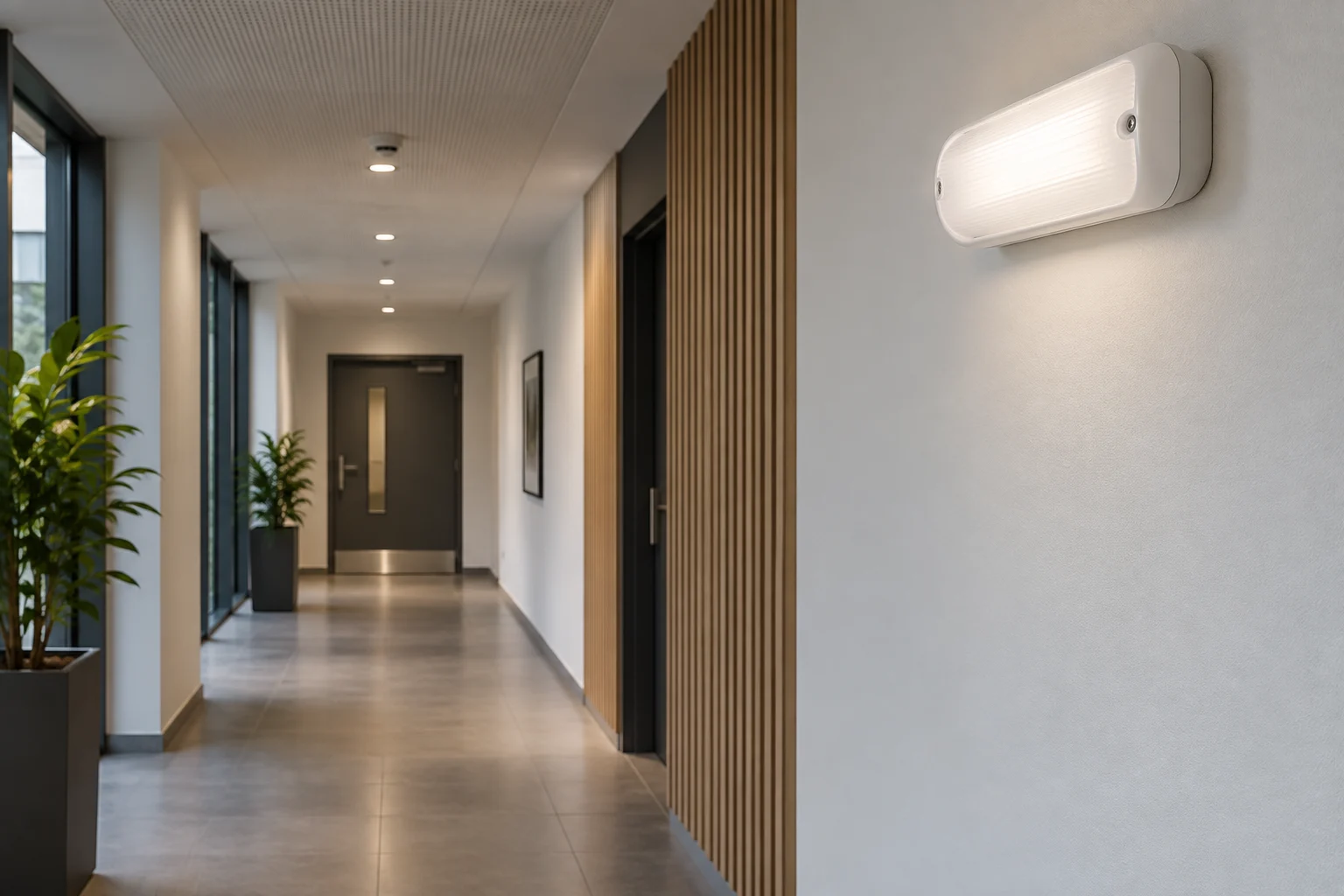
Emergency lighting is the one fire safety system nobody notices until the mains drops. It sits on charge for years, and the only way to know a fitting will still light an escape route is to discharge it on purpose and watch what happens.
This guide sets out the test intervals, who carries the legal duty in Northern Ireland, what the log book has to contain, and what an inspector will ask to see.
The emergency lighting test schedule
| Check | How often | What is actually done | Where it comes from |
|---|---|---|---|
| Indicator check | Daily | Look at the healthy supply indicators on a central battery unit, a generator set or a monitored panel and confirm the system is reading normal. Nothing is discharged and no supply failure is simulated. | BS EN 50172 |
| Function test | Monthly | Interrupt the normal lighting supply for long enough to see every luminaire and every internally illuminated exit sign come on, then restore the supply and check the charging indicators. | BS EN 50172 |
| Full rated duration test | Annually | Every luminaire and sign runs on battery for its full rated duration, normally three hours, and has to still be giving useful light at the end. Supply restored afterwards, charging indicators checked. | BS EN 50172 and BS 5266-1 |
| Recording | After every check | Date, who carried it out, the result, every fitting that failed, and the remedial work with the date it was completed, entered in the log book. | BS EN 50172 |
| Verification of light levels | Every five years | Measured illuminance on escape routes, open areas and high risk task areas checked against BS EN 1838. This is new in the 2024 edition of the standard. | BS EN 50172:2024, clause 7.4.5 |
| Completion documentation | At handover and after any alteration | A completion certificate covering design, installation and verification, handed over with the log book, the as fitted drawings and the operating instructions. | BS 5266-1 |
Which edition of the standard applies
Both of the standards behind that table changed recently, and a lot of test paperwork still quotes the old ones.
- BS 5266-1:2025 replaced BS 5266-1:2016 on 31 October 2025, and the 2016 edition is withdrawn. The new edition updates its references to BS EN 50172:2024 and BS EN 1838:2024, and widens the scope to cover local area lighting and standby lighting as well as escape lighting.
- BS EN 50172:2024, also published as BS 5266-8:2024, replaced the 2004 edition on 31 July 2024. It adds an initial verification of photometric performance against BS EN 1838 at clause 7.3, the five yearly illuminance measurement at clause 7.4.5, and more detail on handover documentation, automatic test systems and the log book.
A certificate that quotes BS 5266-1:2016 does not make your building unsafe. It does mean the next inspection should be carried out and certified against the current editions, and that the five yearly light level verification is now something to plan for.
Why the annual test takes three hours
Most non domestic premises in Northern Ireland are designed on a three hour duration, because the lighting has to last long enough for everyone to get out and for the fire and rescue service to work in the building afterwards. A one hour rated system is only acceptable where the premises is evacuated immediately when the lighting fails and is not reoccupied until the batteries have recharged, which rules out almost every shop, office, hotel and licensed premises.
The point of the annual test is the battery, not the lamp. A tired fitting will flash up brightly the moment you press the test key and still be dark long before three hours are up, which is exactly the failure a monthly function test cannot find.
One practical consequence is worth planning for. After a full discharge the batteries are flat, and the standards allow up to 24 hours for them to recharge to full rated duration. Until that is done the building is not at full protection, so the test belongs at the start of a quiet period rather than the day before your busiest weekend.
Who is legally responsible in Northern Ireland
Northern Ireland does not use the Regulatory Reform (Fire Safety) Order 2005 that applies in England and Wales, so guidance written for a business in Manchester does not quite fit a business in Magherafelt. The duties here come from Part 3 of the Fire and Rescue Services (Northern Ireland) Order 2006 and the Fire Safety Regulations (Northern Ireland) 2010.
- Article 25 of the 2006 Order places duties on an employer for the safety of employees.
- Article 26 places duties on the person who has control of the premises, which can be the owner, the landlord, a managing agent or the occupier depending on the lease.
- Guidance from the Northern Ireland Fire and Rescue Service calls whoever holds those duties the appropriate person. It is the Northern Ireland equivalent of the responsible person elsewhere in the United Kingdom.
Two regulations do the work for emergency lighting. Regulation 13 of the 2010 Regulations requires that “emergency routes and exits requiring illumination shall be provided with emergency lighting of adequate intensity in the case of failure of their normal lighting”. Regulation 16 then requires that fire safety facilities, equipment and devices “are subject to a suitable system of maintenance and are maintained in an efficient state, in efficient working order and in good repair”.
The monthly and annual tests are how the appropriate person demonstrates regulation 16 for emergency lighting. A competent person can be appointed to carry the work out, and most premises do exactly that, but the legal duty stays with the appropriate person. It is not transferred by signing a maintenance contract.
Regulation 16 also lets the duty holder make arrangements with the occupiers of other premises in the same building. That matters in Northern Ireland town centres, where a Victorian building is often split into a ground floor unit and offices above with one shared stair. Common escape routes are where responsibility is most often assumed rather than agreed, and where a set of untested fittings tends to be found.
What the log book must contain
The log book is the evidence. Without it, a perfectly maintained system looks identical to one that has never been tested. It should record:
- the date the system was commissioned, with the completion certificate for the original installation
- the date and result of every daily, monthly and annual check
- who carried out each check
- every defect found, the fitting or sign affected, the remedial action taken and the date it was completed
- every alteration or extension to the system, with the certificate that goes with it
- where an automatic test system is fitted, a description of the device, how it operates and the results it has recorded
Keep it on the premises and keep it current. It is the first document anyone asks for, and a log book that stops abruptly on the date a building changed hands is a recognised warning sign rather than a paperwork detail.
What happens at an inspection
Fire safety officers from the Northern Ireland Fire and Rescue Service inspect relevant premises, and a fire risk assessor or an insurer’s surveyor will ask for much the same evidence. In practice you are asked for four things: the log book, the completion certificate, the most recent annual duration test result, and proof that anything which failed has been put right.
The problems that come up again and again are not exotic:
- monthly tests recorded diligently, with no annual duration test anywhere in the last twelve months
- fittings that light up on the test key but do not last the rated duration, almost always an aged battery
- a log book that stops on the date the building was sold or relet
- an escape route changed in a refit, so the lighting follows a route nobody now uses and the new one has none
- external final exits and the route away from the building left out of the design entirely
- illuminated exit signs treated as signage and never discharged
Where emergency lighting is not being maintained, the fire and rescue service has statutory powers to require it to be put right, and failing to comply is a criminal offence. Insurers take an interest for their own reasons, and a missing test record is a straightforward thing for them to point at.
Practical points for premises in Northern Ireland
A few things come up repeatedly on sites here.
- A power cut is not a test. Winter storms take the mains out often enough along the north coast and in the west that people assume a real outage counts. It does not, because nobody walked the escape routes with a checklist and nothing was written down.
- Subdivided buildings drift out of compliance quietly. A unit split into two tenancies, or an office floor reconfigured around new partitions, leaves the emergency lighting following an escape plan that no longer exists.
- Cold and damp shorten battery life. Fittings in unheated stores, plant rooms, external canopies and stairwells age faster than the ones in a warm office, and they are usually the first to fail a duration test.
- Inherited buildings need a baseline. If you have taken on premises with no paperwork, the honest starting point is a survey and a full discharge test, so you know what you actually have before you commit to a routine.
Self testing and automatic test systems
Self contained fittings with built in self test, and addressable central systems, will run the monthly and annual tests to a schedule and record the results. That removes the two most common causes of failure: the diary and the person who left.
They do not remove the duty. Somebody still has to read the results and act on the failures, and the standard expects the device and its mode of operation to be described in the log book alongside its recorded output. The 2024 edition of BS EN 50172 added requirements covering automatic test systems, so if you are specifying one now it is worth asking the installer to confirm it is being commissioned against the current edition.
Frequently Asked Questions
Can I test my own emergency lighting?
Yes. The monthly function test can be done in house where the premises has a proper test facility, usually a key switch or a test switch that isolates the lighting circuit, and the person doing it knows what a pass looks like. The annual full duration test and the certification that goes with it are normally done by a qualified electrical contractor, because a fitting that fails has to be diagnosed and put right, not just noted.
Do you have to be qualified to test emergency lighting?
The law asks for a competent person, which means training, knowledge and experience appropriate to the work rather than one named qualification. Reading indicators and operating a test key is within reach of most site staff. Carrying out and certifying the annual duration test, and any remedial work on the wiring, is work for a qualified electrician working to BS 5266-1.
How long does an emergency light test take?
The monthly function test takes a few minutes in a small premises, long enough to walk the escape routes and see every fitting and exit sign lit. The annual test runs for the full rated duration, normally three hours, and the fittings have to still be lit at the end, so it is usually booked as a half day on site including the walk round and the paperwork.
How much does an emergency lighting test cost?
It depends on how many luminaires and signs are on site and how easy they are to reach, so we do not publish a rate that would be wrong for most buildings. We survey the premises, count the fittings, and give you a fixed quote after a free survey, with nothing added afterwards.
Do you need a certificate for emergency lighting?
You need a completion certificate when the system is first installed and again after any alteration, covering the design, the installation and the verification. There is no annual certificate named in law, but the annual duration test result has to be recorded, and most contractors issue a periodic inspection and test certificate that goes into the log book alongside it.
Summary
Daily indicator check where there is a central system, monthly function test of every fitting and sign, annual test at the full rated duration, and a light level verification every five years under the 2024 edition of BS EN 50172. Record all of it in the log book, keep the log book on site, and remember that the legal duty under the Fire and Rescue Services (Northern Ireland) Order 2006 sits with the appropriate person whoever does the testing.
Our engineers are qualified to carry out emergency lighting testing and remedial work to BS 5266-1, and every visit produces a written result for your log book and commissioning documentation where the system has been altered.
Related reading
- Service page: Emergency lighting installation and testing in Northern Ireland
- Local coverage: Emergency lighting in Belfast
- Local coverage: Emergency lighting in Coleraine
- Related guide: How often should fire extinguishers be serviced?
- Related guide: What does a fault light on my fire alarm panel mean?
- All of our guides: Knowledge Base