
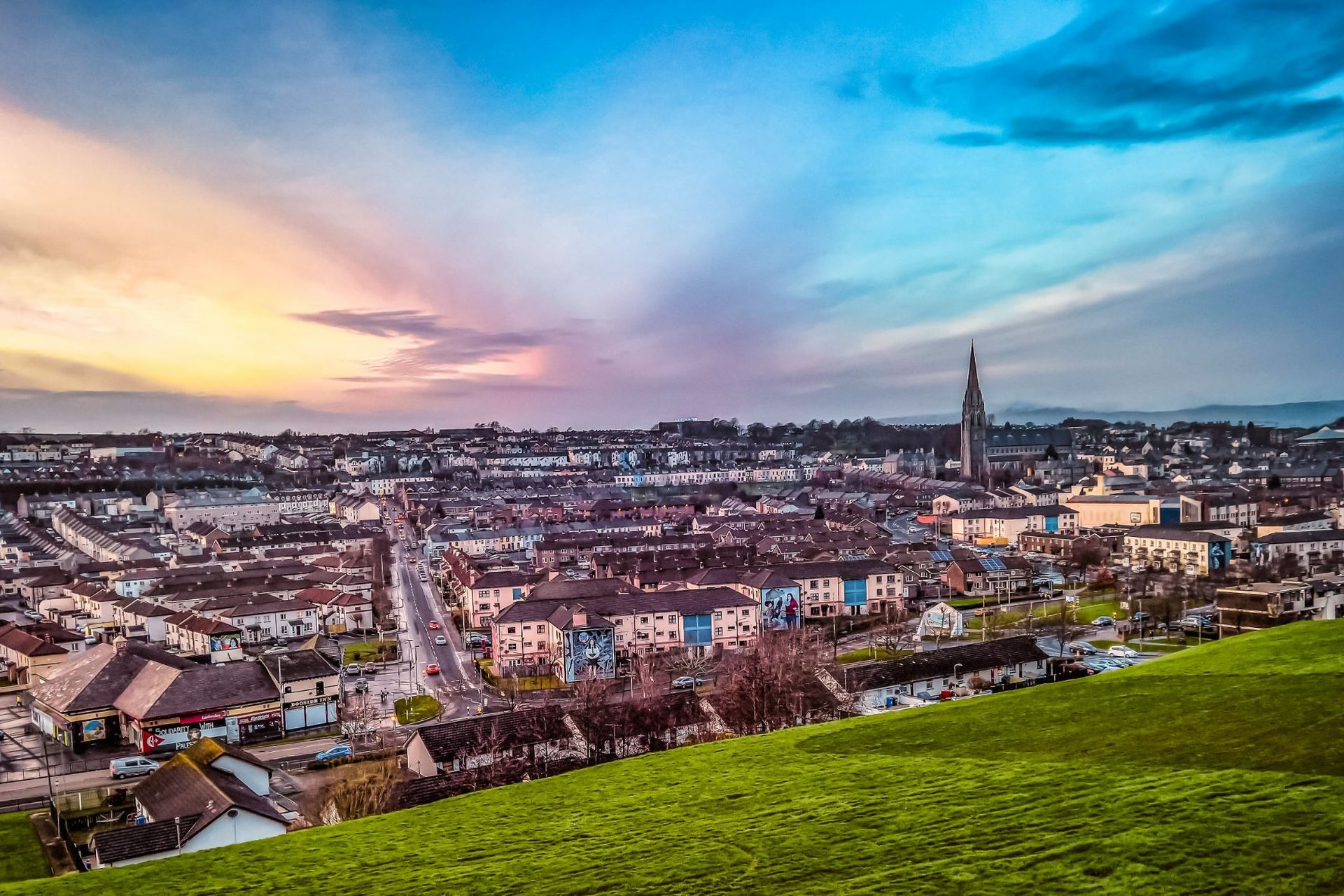
Emergency Lighting Derry (Londonderry)
Professional emergency lighting systems for homes and businesses in Derry, installed and maintained by one local Northern Ireland team.
Derry, covered from Coleraine
Emergency Lighting in Derry, done properly
Advanced Overwatch installs and maintains emergency lighting systems throughout Derry and the surrounding area, residential, retail, commercial and industrial. We design each system around your property, then look after it for the long term.
Emergency lighting installation and testing across Derry and the whole of Northern Ireland. Our engineers are based in Coleraine and cover the region, so a Derry system is installed and tested by the same team, with the certification you need for your records. Book a free site survey on 028 7087 8077.
New Emergency Lighting Installations
We design and install emergency lighting systems for new builds, major renovations, and existing premises that lack compliant coverage. An emergency lighting installation is not simply about placing a bulkhead fitting in a corridor, it requires a documented illuminance calculation to demonstrate that every point along an escape route meets the minimum 1 lux at floor level, that open areas (defined as any space larger than 60m²) receive the required 0.5 lux mean illuminance, and that all fire exits, exit signs, and emergency equipment locations are clearly illuminated.
Our installations use only certified equipment from established manufacturers. We do not use grey-import or unbranded components. For most commercial installations in Derry, we specify maintained LED fittings, which draw less power than older fluorescent bulkhead fittings and run cooler, which matters in confined service areas. Warranty terms vary by manufacturer, so we confirm them against the product datasheet at design stage and record them in the handover pack.
A typical new installation in Derry includes:
- Full survey and illuminance calculation (lux level mapping)
- Design drawings showing fitting positions, cable routes, and circuit designations
- Installation by qualified, experienced electricians
- Commissioning, including a full duration test (draining batteries to confirm the full rated duration is met)
- BS 5266 completion certificate and O&M manual
- Building control notification where required
Emergency Lighting Testing and Inspection
BS 5266-1 requires a documented testing regime. The monthly functional test takes a few minutes per fitting, a brief interruption of the supply to confirm the fitting illuminates and the battery is holding charge. The annual full-duration test is more involved: each fitting must run on battery supply for its full rated duration (typically three hours for escape route lighting) to confirm the battery and lamp are performing to specification.
We provide both regime types:
- Monthly functional test visits, a rapid, systematic inspection of all fittings across your premises, with test results recorded in a log book (physical or digital)
- Annual full-duration test, the complete discharge test with full documentation, certificate issuance, and a written condition report recommending any replacements needed before the next test cycle
For property owners and landlords in Derry with multiple premises, a shop on Strand Road, a flat above on Waterloo Place, an office unit at Fort George, we offer portfolio maintenance contracts that cover all sites under a single agreement, with a single invoice and a consolidated test record. Our guide covers the five yearly light level verification and the rest of the schedule that a consolidated record has to show.
Who in Derry needs emergency lighting?
The short answer is: almost every non-domestic building and any residential building above a certain height or occupancy type. The most common Derry client categories we work with are:
- Licensed premises (pubs, clubs, restaurants, hotels), Derry’s vibrant hospitality sector on the Strand Road corridor and in the Cathedral Quarter means licensed premises are prevalent. Emergency lighting is required in all areas accessible to the public and all staff-only areas, including kitchens, cellars, and service corridors.
- Offices and commercial buildings, From small professional offices above retail on Shipquay Street to the larger office campuses at Fort George and Ebrington, all commercial offices require compliant emergency lighting.
- Retail premises, Foyleside Shopping Centre units, Strand Road retail park, and independent shops throughout the city. Larger retail units with floor areas exceeding 60m² require open-area emergency lighting in addition to escape route coverage.
- Educational facilities, Schools, colleges, and training centres, including the Ulster University Magee campus buildings.
- Healthcare and care settings, Altnagelvin Area Hospital site, dental practices, care homes, and supported living accommodation.
- Industrial and warehouse units, Industrial estates on the Cityside and Maydown Business Park, where large open-plan spaces present specific emergency lighting design challenges.
- HMO properties and flats, Any House in Multiple Occupation or block of flats above two storeys requires emergency lighting in common parts.
- Landlords and property managers, Property companies with portfolios across the Derry and Strabane district use our maintenance contracts to ensure all their properties remain compliant without managing multiple contractors.
Emergency Repair
Fittings fail. Batteries age. Circuit faults occur. When an emergency light is not functioning, your premises is technically non-compliant until it is restored. We handle repair callouts across the Derry district, including the Cityside, Waterside, and surrounding towns out to Strabane, Dungiven, and Limavady, with out-of-hours support and priority given to existing customers. We carry common replacement fittings and know the systems we have previously installed, so faults are diagnosed quickly and put right as soon as parts and access allow.
Integration with Fire Alarm Systems
Emergency lighting and fire alarm systems are often treated as separate trades, but they are fundamentally linked. A fire detection event should trigger the emergency lighting system to illuminate escape routes automatically. We install integrated systems where the fire alarm panel provides a signal to the emergency lighting control gear, ensuring that in a fire scenario, occupants are not relying on a system that depends solely on a power failure, the alarm system provides the first activation signal.
For premises with a monitored fire alarm, including commercial properties with an Alarm Receiving Centre connection, we can link emergency lighting activation to the monitoring contract, so the operator receives confirmation that emergency lighting has activated during a fire event.
Why Derry businesses and property owners need emergency lighting
Derry is Northern Ireland’s second-largest city and the administrative and commercial hub of the North West. Its building stock is among the most varied in the country, from Georgian terraces in the historic core and Victorian warehouses along the River Foyle to modern healthcare facilities, large retail parks, hospitality venues, and industrial estates across the Waterside and Cityside. Every commercial building, educational establishment, healthcare facility, and multi-occupancy residential building in Derry is legally required to have emergency lighting installed and maintained to BS 5266 standards.
The regulatory landscape is clear. Under the Fire and Rescue Services (Northern Ireland) Order 2006 and associated building regulations, emergency lighting is mandatory in virtually all non-domestic premises. BS 5266-1:2025 sets the design, installation, and maintenance code of practice. For premises with sleeping accommodation, hotels, guest houses, HMO properties, and certain social housing, there are additional requirements. The Regulatory Reform (Fire Safety) Order 2005 (applicable in England and Wales) and its Northern Ireland equivalent place the responsibility for compliance squarely on the appropriate person, which means business owners and landlords in Derry cannot defer this obligation.
For Derry’s commercial sector, non-compliance carries real consequences. The Western Health and Social Care Trust operates major facilities including Altnagelvin Area Hospital and the South West Acute Hospital in Enniskillen, both require fully maintained emergency lighting systems with documented inspection regimes. The city’s retail parks, including Foyleside, the Strand Road hotel and hospitality corridor, and the growing Ulster University Magee campus all present ongoing emergency lighting maintenance requirements. For landlords and property management companies with portfolios across the Derry and Strabane district, a missed maintenance cycle or an incomplete test record can invalidate insurance cover and expose directors to personal liability.
Advanced Overwatch provides complete emergency lighting services across Derry and the North West: initial installation, periodic testing, emergency repair, and maintenance contracts. We hold ISO 9001, ISO 14001, ISO 27001 and ISO 45001 certification. All work is fully documented, with certificates issued for insurance companies, building control, and Fire and Rescue Service inspection.
Qualified, audited and independent
Independently certified and answerable only to our customers, no franchise, no head-office script, one local Coleraine team.
- Est. 2017
- ISO 9001
- ISO 14001
- ISO 27001
- ISO 45001
Advanced Overwatch is SSAIB certificated (NIRE127) specifically for Intruder Alarm Systems, Visual Surveillance Systems (VSS) and Access Control Systems. It does not cover fire alarm work or emergency lighting, which we carry out to BS 5266 with qualified engineers and commissioning documentation.
Derry / Londonderry crime at a glance
Within 1 mile of the town centre. Includes anti-social behaviour.
Recorded incidents
430 in the same month last year
August 2025
Most recorded categories
Bars show each share of the monthly total.
- Violence & Sexual Offences147
- Anti-Social Behaviour139
- Criminal Damage & Arson49
- Other Theft22
- All other categories52
Explore the monthly trends, recorded locations and local comparisons.
View full Derry / Londonderry crime reportThese are recorded incident counts, not population-adjusted rates or a prediction of an individual property’s risk.
Source: PSNI via data.police.uk. About these figures
Source: Police Service of Northern Ireland via data.police.uk (UK Police API), data to August 2026. Contains public sector information licensed under the Open Government Licence v3.0. Locations are anonymised map points; a small number of crimes without usable locations are excluded. Figures describe a fixed 1-mile radius around the town centre, not council or town boundaries, see our methodology.
Emergency Lighting security in Derry, your questions
Does my Derry business need emergency lighting by law?
Yes, in virtually all cases. Under BS 5266-1:2025 and applicable building regulations, emergency lighting is required in all non-domestic premises in Northern Ireland. This includes all commercial buildings, places of entertainment, educational establishments, healthcare facilities, and residential buildings in multiple occupation. The specific specification depends on the type and use of the premises, a 4-storey office building has different requirements from a single-storey shop. If your building has a fire alarm system, it almost certainly requires emergency lighting to complement it. A free survey from Advanced Overwatch will confirm exactly what is required for your specific premises.
How much does emergency lighting installation cost in Derry?
A compliant emergency lighting installation for a typical small commercial premises (a shop or small office, say 200 to 400m²) covers the supply and installation of fittings, containment, and documentation. Larger premises, premises requiring high-dependence system design, or buildings where emergency lighting must integrate with a fire alarm system will cost more. We provide a fixed-price quote following a free on-site survey, we assess the property, calculate the required lux levels, and return a price with no hidden extras. Maintenance contracts for ongoing compliance testing are also available for small premises.
What is BS 5266 and why does it matter for my Derry property?
BS 5266-1:2025 is the British Standard Code of Practice for emergency lighting. It defines the minimum illuminance levels required (1 lux minimum along escape routes at floor level, 0.5 lux mean in open areas over 60m²), specifies the duration of battery backup (minimum one hour for most premises, three hours for hotels and larger commercial buildings), sets rules for the positioning of exit signs and emergency escape lighting, and defines the required testing regime. Compliance with BS 5266 is the standard expected by building control, Fire and Rescue Service inspectors, and insurance companies. An installation that is not designed to BS 5266 may not provide adequate illumination in an emergency, and a premises owner who cannot produce BS 5266 test documentation may face difficulties with insurance claims and regulatory enforcement.
How often does emergency lighting need to be tested in Northern Ireland?
By law, functional tests must be carried out monthly and full-duration tests annually. Monthly tests are brief, a few seconds to confirm each fitting is operating, and can be carried out by your own staff once they have been trained on the procedure (we include this as part of our maintenance contract handover). Annual full-duration tests must be conducted by a competent person with appropriate qualifications and instrumentation; the results must be documented and certificates issued. BS 5266 also recommends that a full inspection and condition report is produced at five-year intervals to assess the overall condition of the installation and plan for component replacement.
Can emergency lighting be integrated with my existing fire alarm system in Derry?
Yes, and in many cases it should be. Modern emergency lighting control gear can be connected to a fire alarm panel so that when a fire is detected, the emergency lights activate immediately, illuminating escape routes before the mains supply is even interrupted. This is particularly valuable in larger premises where the distance from the fire to the nearest exit may be significant. We install integrated systems using compatible equipment from each manufacturer. If your fire alarm is an addressable or enhanced system, we work with your fire alarm contractor to ensure the integration is correctly configured and tested.
How quickly can you get to Derry?
We cover the whole of Northern Ireland, Derry included. Call us on 028 7187 8123 or book a free survey and we will arrange a convenient time to visit your Derry property.
Do you install emergency lighting systems in Derry?
Yes. Advanced Overwatch designs, installs and maintains emergency lighting systems for homes and businesses across Derry and the surrounding area. Derry is one of the areas we cover, we are one local Northern Ireland team, not a franchise or a call centre.
Derry emergency lighting, areas we cover
Our emergency lighting engineers cover the whole of the Derry City and Strabane District Council area across Northern Ireland, including:
Derry City Centre, The Walls, Cathedral Quarter, Shipquay Street, Waterloo Street, Strand Road, Queens Quay, Foyleside, Irish Quarter, and the Bogside
Waterside, Altnafearn, Ebrington, Pennyburn, Caw (Kilfennan), Tullyally, Gobnascale, and the Northland Industrial Estate
Cityside, The Fountain, Brandywell, Creggan, Shantallow, Galliagh, and the Culmore Road area
Surrounding towns and districts, Strabane, Dungiven, Limavady, Castlederg, Newbuildings, and the rural townlands across County Londonderry
Note: We also serve properties in adjacent areas of County Donegal within reasonable reach of Derry, including Burnfoot, Moville, and the Inishowen peninsula. Contact us to discuss your location.
Nearby coverage
We also cover the area around Derry
One Coleraine team, region-wide reach, explore neighbouring towns we protect, or see the full coverage map.
For emergency lighting itself, see the emergency lighting design and installation service, or the same work written up for Strabane and Omagh.
Protect your Derry property with one local team
Book a free, no-obligation survey and we will design the right emergency lighting system for your Derry home or business, installed and maintained by our own engineers.
Thousands of premises secured since 2017