
Most businesses in Northern Ireland need a Grade 2 intruder alarm system under EN 50131 as applied by PD 6662:2017. If you hold high-value stock, process significant cash, or your insurer specifies it, you will likely need Grade 3. The correct grade depends on your risk profile, occupancy pattern, and insurance requirements. SSAIB certificated installation is required to qualify for PSNI police response. Advanced Overwatch installs Grade 2 and Grade 3 commercial alarm systems across Northern Ireland, with monitoring through our partner NSI Gold certified Alarm Receiving Centre.
Choosing an intruder alarm for your business should not come down to a salesperson’s preference or the cheapest quote on the day. The system that protects your premises needs to be correctly specified to your risk profile, compliant with the relevant European standard, and installed by a certified company if you want police response and insurance acceptance.
This guide explains exactly what you need to know as a business owner in Northern Ireland: from the standards that govern alarm installations to the grades, communication paths, and process for registering your system with the PSNI.
The Standard That Governs Business Intruder Alarms in Northern Ireland
All intruder alarm systems installed in commercial premises across the UK, including Northern Ireland, are governed by EN 50131: the European Standard for intruder and hold-up alarm systems. In practice, EN 50131 is applied in the UK through PD 6662:2017, a Published Document from the British Standards Institution that adapts the European standard for UK installation practice.
PD 6662:2017 specifies how alarm systems should be designed, specified, installed, commissioned, and maintained. It replaced the older framework built around BS 4737, which was withdrawn as the primary installation standard when EN 50131 became mandatory for UK systems from 2011 onwards.
If your installer is not working to EN 50131/PD 6662:2017, your system may not be accepted by your insurer or by the PSNI for police keyholder response. This is a non-trivial risk: particularly for businesses that believe they are protected when the paperwork says otherwise.
Key requirements under PD 6662:2017 include:
- A formal system specification referencing the correct grade (Grade 1, 2, 3, or 4)
- Installation by a company certified by a UKAS-accredited certification body such as SSAIB or NSI
- Commissioning documentation and an installation certificate issued to the client
- A maintenance programme: typically two service visits per year for Grade 2 and Grade 3 systems
Understanding Alarm Grades: What Grade Does Your Business Need?
EN 50131 defines four grades of intruder alarm, each designed for a different risk level. The grade determines the detection performance, tamper protection, tamper detection requirements, and signalling path needed between your system and the Alarm Receiving Centre (ARC).
| Grade | Risk Level | Typical Application | Signalling Requirement |
|---|---|---|---|
| Grade 1 | Low | Small, low-value premises, minimal intrusion risk | Not typically ARC-monitored |
| Grade 2 | Medium | Most SME offices, retail, warehouses, hospitality | Single or dual-path to ARC |
| Grade 3 | High | High-value goods, cash-intensive businesses, pharmaceutical, utilities | Dual-path to ARC mandatory |
| Grade 4 | Very High | Critical national infrastructure, high-security government | Rarely applied commercially |
For most businesses in Northern Ireland, the answer is Grade 2.
Grade 2 covers the large majority of commercial premises: offices, warehouses, retail units, hotels, light industrial facilities, and general mixed-use commercial buildings. A correctly specified Grade 2 system under PD 6662:2017, installed by an SSAIB certificated company and monitored by an approved ARC, satisfies most commercial insurers and qualifies for PSNI URN registration.
When Does a Business Need Grade 3?
You will typically need Grade 3 if one or more of the following apply:
- Your insurer specifies Grade 3 in the policy schedule or proposal
- You hold or handle high-value goods: jewellery, high-end electronics, pharmaceutical products, or tobacco
- Significant cash is processed, held, or stored on-site
- Your premises is assessed as being at heightened intrusion risk based on location or prior incidents
- You operate as a cash-in-transit contractor, security business, or similar regulated sector
Grade 3 requires enhanced tamper protection throughout the system, dual-path signalling to the ARC, and more rigorous commissioning documentation. The detection components: PIR detectors, door contacts, vibration detectors: must also meet a higher performance specification than Grade 2 equivalents.
ARC Monitoring and PSNI Police Response: What You Need to Know
A common misconception among business owners is that installing any alarm means the police will respond when it activates. In Northern Ireland, this is not automatic. Police response to an intruder alarm activation is governed by a formal process managed by the PSNI.
For PSNI keyholder or police response, your system must meet all of the following:
- Installed by an SSAIB or NSI-approved company: these are UKAS-accredited certification bodies. Approval means the installer has been independently assessed for technical competence, workmanship quality, and business practice.
- Monitored by an Alarm Receiving Centre (ARC): the ARC must hold its own SSAIB or NSI certification. It receives alarm signals 24/7, verifies the activation, and either contacts keyholders or escalates to PSNI.
- Registered for a URN (Unique Reference Number): the PSNI issues URNs for qualifying alarm systems. The URN links your site address to the PSNI response system. Without it, police will not attend regardless of how your alarm activates.
Advanced Overwatch is SSAIB certificated (NIRE127) specifically for Intruder Alarm Systems, Visual Surveillance Systems (VSS) and Access Control Systems. All systems we install are eligible for URN registration, and we manage the application process on behalf of our clients.
What Happens If You Buy a Non-Certified System?
Retail alarm systems: marketed online or through general electrical contractors without SSAIB or NSI certification: cannot be registered for PSNI response. If your system activates at 3am, your monitoring station (if you have one) may call you, but PSNI will not attend. Your insurer may also reject a claim if the installation does not meet the standard specified in your policy.
The cost difference between a certified and non-certified installation is often far smaller than business owners assume, particularly for Grade 2 systems on standard commercial premises.
Wired vs Wireless: Which Is Right for Your Premises?
Both wired and wireless intruder alarm systems can meet Grade 2 and Grade 3 requirements under EN 50131. The choice between them is determined by your building structure, the practicality of cable installation, and the level of system intelligence you need.
Hardwired Systems
Traditional hardwired alarm systems use cable runs between the control panel, detectors, and sounders. They are well-suited to:
- New build commercial premises with cable routes incorporated during construction
- Buildings undergoing significant refurbishment where cable installation is straightforward
- Large-footprint sites where the reliability of a physical connection is preferred
Wireless Systems
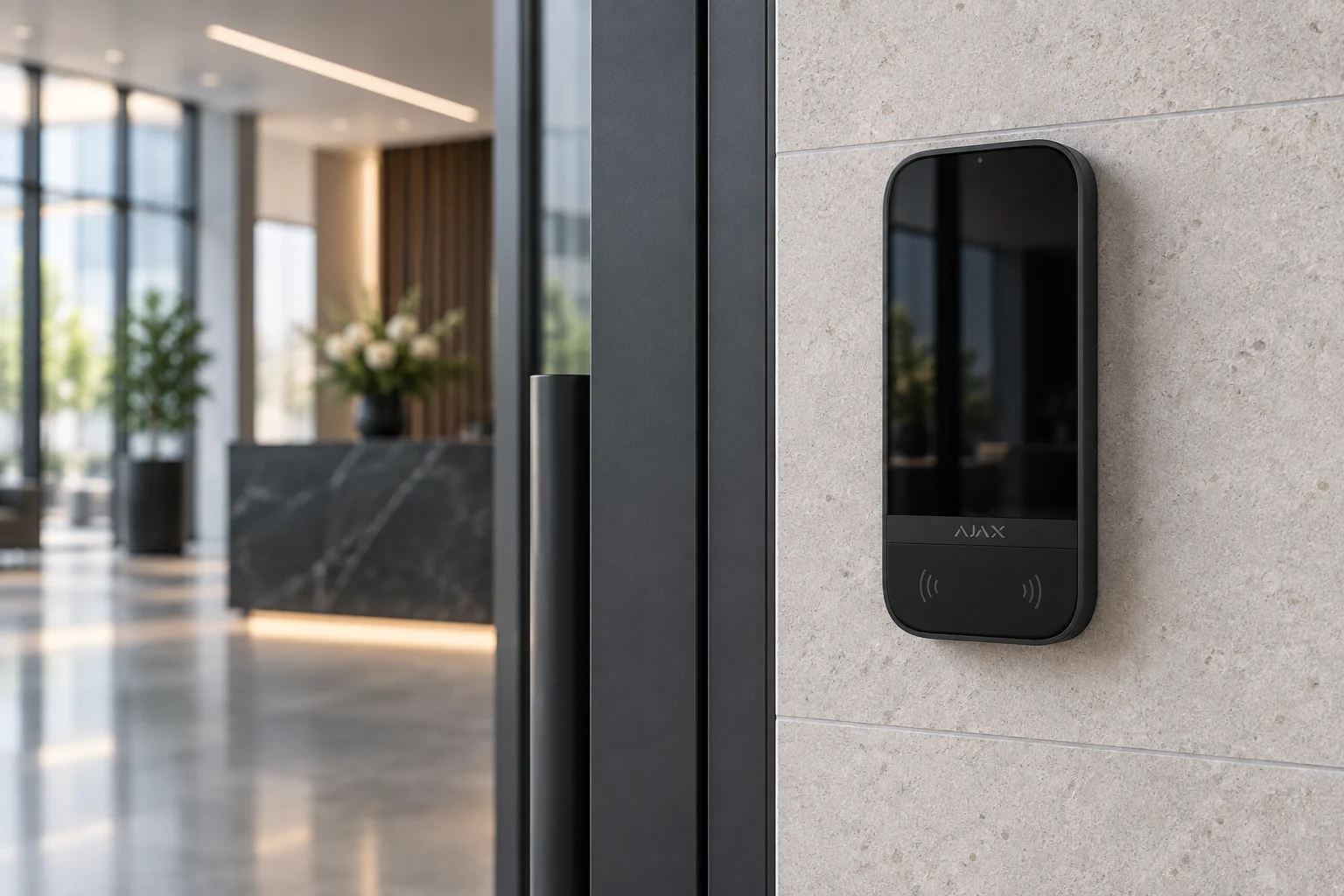
Modern wireless alarm systems: Advanced Overwatch is a specialist installer of Ajax Systems products: use encrypted radio frequency communication between devices and the control panel. Ajax operates on the 868 MHz frequency band with end-to-end encryption and two-way device communication.
Wireless systems are well-suited to:
- Retrofit installations in occupied premises where cable disruption must be minimised
- Heritage or listed buildings where drilling cable routes is restricted
- Multi-site businesses needing fast deployment with centralised remote management
- Grade 2 and Grade 3 commercial applications where system intelligence matters
Professional Insight: At Advanced Overwatch, we have migrated a significant number of commercial clients from older wired control panels to Ajax wireless platforms. The primary driver is not installation convenience: it is operational visibility. Ajax gives the monitoring centre and the client real-time device-level status. When an activation occurs at a commercial site outside business hours, we can tell immediately whether the trigger was a PIR detector, a door contact, a hold-up button, or a tamper event. That information changes how our partner ARC responds and how quickly PSNI receives an accurate picture of what is happening on site.
Communication Paths: Single-Path vs Dual-Path Signalling
How your alarm communicates with the ARC is specified in PD 6662:2017 and draws on the requirements in EN 50136, the European Standard for alarm transmission systems.
- Single-path signalling: The system communicates via one channel: typically broadband (Ethernet) or GPRS. Acceptable for standard Grade 2 applications.
- Dual-path signalling: The system communicates via two independent channels simultaneously: typically broadband combined with cellular (4G). Required for Grade 3 and for insurance policies specifying enhanced Grade 2 requirements.
Most commercial property insurers in Northern Ireland now require dual-path signalling as a minimum condition of cover for business premises. Before your alarm is specified, request a copy of your current policy schedule and check for any signalling path requirement. If it references “DP” signalling or specifies dual-path, your installer must configure the system to match.
Ajax Hub 2 Plus panels support native dual-path signalling through dual-SIM cellular plus Ethernet connectivity: making Grade 3 dual-path compliance technically straightforward in both retrofit and new-build commercial environments.
What Does a Commercial Intruder Alarm Installation Cost in Northern Ireland?
Cost is set by the system grade, the number of detection zones, any monitoring, and a wired or a wireless installation. The main factors are:
- System grade (Grade 2 or Grade 3)
- The number of detectors, door contacts and detection zones
- Wired cable routes or wireless coverage requirements
- Signalling path (single-path or dual-path) and ARC monitoring
- Whether an existing control panel is being replaced
- Ongoing maintenance visits
Accurate pricing for commercial alarm installations requires a site survey: the number of detectors needed, cable routes or wireless coverage requirements, and signalling infrastructure can vary significantly between premises of similar size. We give a clear written quote after a free site survey.
Sectors We Install Commercial Alarm Systems For
Advanced Overwatch installs EN 50131-compliant Grade 2 and Grade 3 intruder alarm systems across Northern Ireland for a wide range of commercial sectors, including:
- Retail and hospitality: Convenience stores, pubs, hotels, restaurants, licensed premises
- Offices and professional services: Solicitors, accountants, healthcare clinics, estate agents, financial services
- Warehousing and logistics: Distribution centres, trade premises, cold storage facilities
- Education: Schools, colleges, community facilities, nurseries
- Manufacturing and industrial: Light industrial units, workshops, processing and production facilities
- Healthcare and pharmaceutical: Pharmacies, dental practices, opticians, medical centres
Each sector has specific detection requirements. A pharmacy, for example, requires careful Grade 3 assessment for controlled drug storage areas. A warehouse needs a detection design that accounts for racking height and potential detector masking. Getting the design right before installation is what separates a system that functions as specified from one that generates nuisance activations or fails at the point it is needed.
The Process: From Survey to Police Response
Here is the step-by-step process for a commercial intruder alarm installation with Advanced Overwatch, from initial contact to active PSNI response capability:
- Site survey: We assess your premises, review your risk profile, confirm the appropriate EN 50131 grade, and specify the correct system.
- Written proposal: You receive a proposal referencing EN 50131, PD 6662:2017, the system grade, detection zones, signalling path, and monitoring arrangement.
- Installation: Most commercial installations take 1-3 days; wireless Ajax systems are typically faster with less disruption to operations.
- Commissioning: System is tested to SSAIB standards; all detectors function-tested; walk tests completed for every zone.
- Certificate issued: SSAIB installation certificate provided; a copy is forwarded to your insurer on request.
- ARC contract: Monitoring agreement in place; system linked to the ARC with correct keyholder details.
- URN application: We apply to PSNI on your behalf for Unique Reference Number registration.
- Active response: System is live with full police response capability and 24/7 ARC monitoring.
First contact to active monitoring usually takes 2-4 weeks for most commercial premises in Northern Ireland.
Get a Free Site Survey from Advanced Overwatch
We install Grade 2 and Grade 3 intruder alarm systems for commercial premises across Northern Ireland: Coleraine, Belfast, Derry, Magherafelt, Omagh, and every county in between. SSAIB certificated (NIRE127) and certified to ISO 9001, ISO 14001, ISO 27001 and ISO 45001. All installations completed to EN 50131/PD 6662:2017 and eligible for PSNI URN registration.
Coleraine: 028 7087 8077
Advanced Overwatch is SSAIB certificated (NIRE127) specifically for Intruder Alarm Systems, Visual Surveillance Systems (VSS) and Access Control Systems. Four ISO certifications sit behind the work: 9001 for quality management, 14001 for environmental management, 27001 for information security and 45001 for occupational health and safety.
Related Questions
Can I use a domestic intruder alarm system in my business premises?
Domestic alarm systems: including those sold in hardware stores or installed by general electricians without SSAIB or NSI certification: are not suitable for most commercial premises in Northern Ireland. They cannot be registered for PSNI police response, as URN registration requires SSAIB or NSI-certified installation. They will not satisfy most commercial insurers, who specify certified Grade 2 or Grade 3 systems as a condition of cover. Beyond the certification issue, domestic alarm systems are not designed for the detection coverage requirements, tamper protection standards, or signalling path performance that EN 50131 Grade 2 commercial applications demand. If you are currently operating with a domestic or uncertified alarm, contact an SSAIB certificated installer for an audit: you may be unprotected without realising it.
What happens to my intruder alarm if my broadband or power goes down?
A properly specified commercial intruder alarm system under PD 6662:2017 must include both mains failure protection and communication redundancy. For power: all EN 50131-compliant control panels include a battery backup sufficient to maintain system operation for a minimum period (typically 12 hours under EN 50131-1 requirements for Grade 2). For communications: dual-path signalling is the correct answer. If your system uses dual-path (broadband plus 4G cellular), a broadband outage will not break the connection to your ARC: the cellular path takes over automatically. If your system uses only single-path broadband signalling and your broadband fails, your ARC loses contact with your premises. This is why many insurers are now specifying dual-path as a minimum requirement, and why Advanced Overwatch recommends dual-path as standard for all new commercial installations regardless of grade.
How do false alarms affect my police response in Northern Ireland?
The PSNI operates a false alarm management policy for alarm systems registered with a URN. If a system generates an excessive number of false activations within a 12-month period, the PSNI may withdraw police response for that system. The threshold is defined in the policy, but generally two or more false activations without an acceptable explanation can trigger a review. False alarms are most commonly caused by: incorrectly specified detectors (wrong sensitivity for the environment), poor commissioning, inadequate maintenance, or human error in setting and unsetting the system. An SSAIB certificated installer will specify detectors correctly for your environment and commission the system to minimise false activation risk. If you are experiencing repeat false alarms, the correct response is a site visit from your installer: not to ignore them and risk losing your police response.
Standards Explained
EN 50131: The European Standard for intruder and hold-up alarm systems. It is a multi-part standard covering system components (control panels, detectors, sounders, communication equipment), installation requirements, and system grading from Grade 1 (low risk) through to Grade 4 (very high risk). EN 50131 replaced the old UK-specific standard BS 4737 as the primary intruder alarm standard from 2011. All commercial intruder alarm systems installed in Northern Ireland should reference EN 50131 in their system specification.
PD 6662:2017: A Published Document from the British Standards Institution that provides the UK-specific application guide for EN 50131. It covers how to select the correct alarm grade for a given premises and risk level, signalling path requirements, installation practice, commissioning, and ongoing maintenance intervals. When an SSAIB or NSI-certified installer in Northern Ireland specifies a commercial alarm system, they are working to PD 6662:2017. Possession of an installation certificate referencing PD 6662:2017 is typically required by commercial insurers.
EN 50136: The European Standard for alarm transmission systems and equipment. It defines how an intruder alarm communicates with the Alarm Receiving Centre (ARC), and classifies communication paths as single-path (SP) or dual-path (DP). Dual-path signalling (DP) requires two independent communication channels: typically broadband and 4G cellular: operating simultaneously. EN 50136 is referenced within PD 6662:2017 for signalling path requirements.
BS 4737: The former British Standard for intruder alarm systems, now withdrawn as the primary installation standard. It was replaced by EN 50131 and PD 6662 from 2011. Systems still described as “BS 4737 compliant” are being specified to a standard that is over a decade out of date and may not meet current insurer or PSNI requirements.
SSAIB (Security Systems and Alarms Inspection Board): A UKAS-accredited third-party certification body that audits and approves security systems companies in the UK, including Northern Ireland. SSAIB certification requires companies to demonstrate technical competence, quality workmanship, appropriate insurance, and financial stability. Only SSAIB or NSI-approved companies can register intruder alarm systems for PSNI police response via URN application. Advanced Overwatch is SSAIB certificated (NIRE127) specifically for Intruder Alarm Systems, Visual Surveillance Systems (VSS) and Access Control Systems.
URN (Unique Reference Number): A reference number issued by the Police Service of Northern Ireland (PSNI) to a specific intruder alarm system at a registered premises. The URN links the site address to the PSNI response system. When the ARC contacts PSNI following an alarm activation, the URN is the identifier that authorises police dispatch. Without a URN, PSNI will not respond to an alarm activation. URNs are only issued for systems installed by SSAIB or NSI-certified companies and monitored by a certified ARC.
ARC (Alarm Receiving Centre): A 24/7 staffed monitoring facility that receives alarm signals from intruder alarm systems. When your alarm activates, the ARC receives the signal, applies verification procedures to assess whether the activation is genuine, attempts to contact your nominated keyholders, and if required, contacts PSNI with your URN. ARCs must hold their own SSAIB or NSI certification: not all monitoring services are certified to the required standard.