
Choosing a CCTV system for your business in Northern Ireland means matching the right cameras, recording hardware, and storage method to your premises, your risk profile, and your compliance obligations. A well-designed system uses IP cameras at the correct resolution (typically 4MP or higher for commercial sites), records to a network video recorder (NVR) with adequate retention, and is installed by an SSAIB certificated company so it meets BS 8418 and UK GDPR requirements. Advanced Overwatch designs and installs commercial CCTV systems across Northern Ireland.
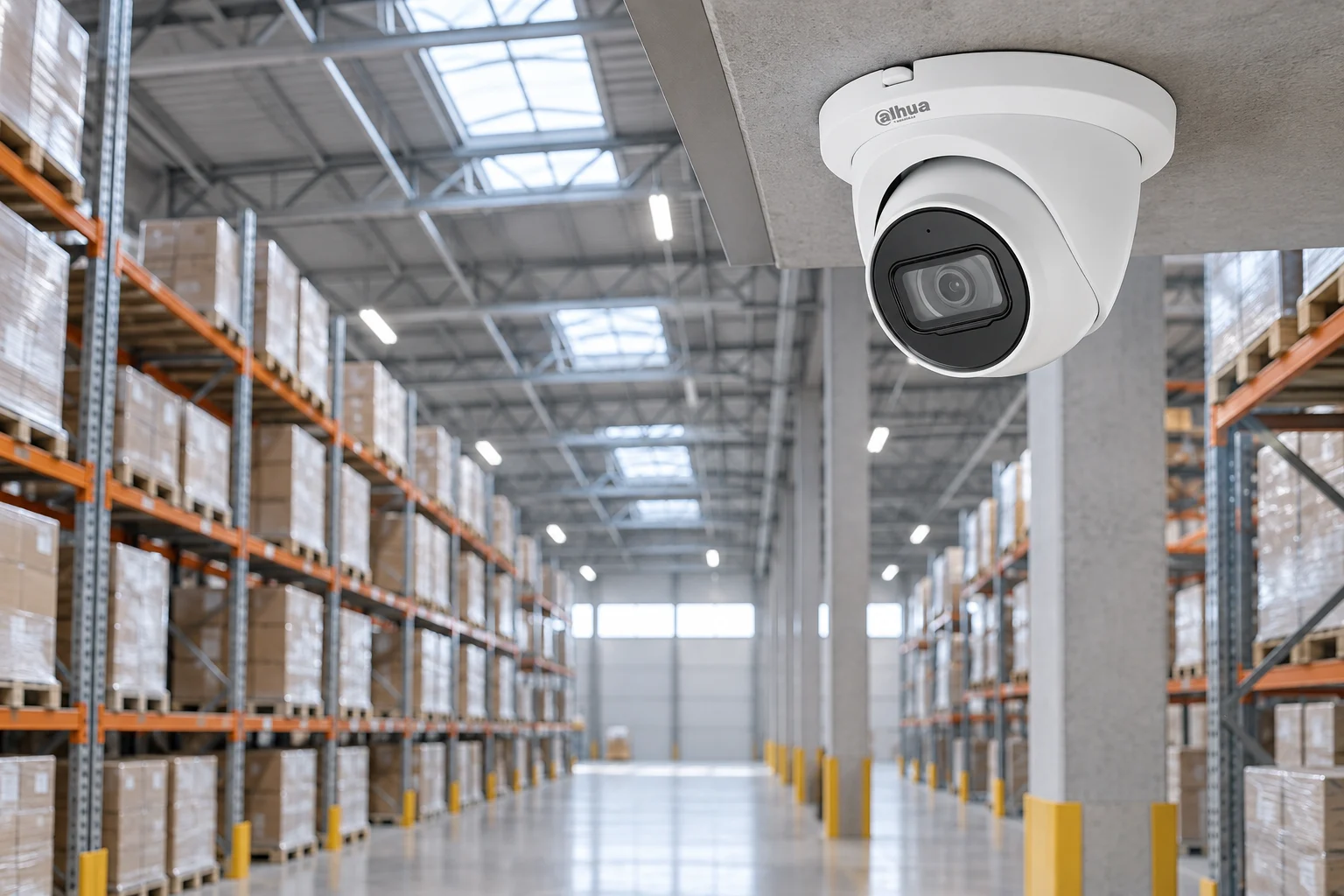
What Makes a Commercial CCTV System Different from a Residential One?
A commercial CCTV system is fundamentally different from a home setup in scale, capability, and compliance burden. Where a residential system might use four cameras and a basic recorder, a commercial installation typically involves 8 to 64 cameras, structured cabling, dedicated network infrastructure, and integration with access control and intruder alarm systems.
The key differences are:
- Camera count and coverage: Commercial premises need overlapping fields of view to eliminate blind spots across larger footprints: car parks, loading bays, reception areas, server rooms, and perimeter fencing all require specific camera types.
- Resolution requirements: Businesses need evidential-quality footage. For most commercial applications, 4MP is the minimum recommended resolution. High-risk areas such as tills, entry points, and stock rooms benefit from 8MP (4K) cameras.
- Recording retention: UK insurers and industry standards typically require 30 days of continuous recording. Some sectors (financial services, healthcare) require longer.
- Compliance: Commercial CCTV must comply with UK GDPR, the Data Protection Act 2018, and ICO guidance on surveillance cameras. If you want your system to qualify for police response or monitoring station connection, it must meet BS 8418.
- Remote management: Business owners and facility managers need remote viewing, push notifications, and the ability to export footage securely: not just live viewing on a monitor in a back office.
Professional Insight
From our experience installing commercial CCTV systems across Northern Ireland: from retail units in Belfast to agricultural facilities in County Tyrone: the biggest mistake businesses make is under-specifying storage. A system with excellent cameras but only 7 days of recording is a liability. By the time most thefts or incidents are discovered and reported, you need footage from two to four weeks ago. We always design for a minimum of 30 days at full resolution with headroom for expansion.
IP Cameras vs Analogue: Which Technology Should You Choose?
The commercial CCTV market has moved decisively to IP (Internet Protocol) cameras. While analogue systems still exist, IP technology offers significant advantages for any business investing in new infrastructure.
| Feature | IP Camera System | Analogue (HD-CVI/TVI) System |
|---|---|---|
| Resolution | 2MP to 32MP+ | Up to 8MP (limited) |
| Cabling | Cat6 Ethernet (PoE) | Coaxial (RG59/shotgun) |
| Recorder | NVR (Network Video Recorder) | DVR (Digital Video Recorder) |
| Power delivery | Power over Ethernet (PoE): single cable | Separate power supply per camera |
| AI analytics | Built-in (perimeter, face, vehicle) | Limited or none |
| Scalability | Add cameras to any network point | Limited by DVR channel count |
| Audio | Two-way audio standard | Separate audio cabling needed |
| Typical cost | 15-25% higher upfront | Lower upfront, higher long-term |
Our recommendation for new installations is always IP. The single-cable PoE infrastructure reduces installation labour, future-proofs the system for AI analytics, and provides significantly better image quality. The only scenario where analogue makes sense is when you are expanding an existing analogue system and a full replacement is not yet in the budget.
What Is PoE and Why Does It Matter?
Power over Ethernet (PoE) delivers both data and electrical power through a single Cat6 cable. This means each camera needs only one cable run back to the NVR or PoE switch: no separate power supplies, no electrician needed at each camera location. For a 16-camera system, PoE can save 30-40% on cabling labour compared to analogue installations. It also means cameras can be powered by an uninterruptible power supply (UPS) at the switch, keeping the entire system running during mains power cuts.
Choosing the Right Camera Resolution: 2MP, 4MP, or 8MP?
Resolution determines how much detail your cameras capture: and whether footage is useful as evidence or merely shows blurred shapes. For commercial CCTV in Northern Ireland, resolution selection should be based on the purpose of each camera position.
| Resolution | Pixel Count | Best For | Typical Use |
|---|---|---|---|
| 2MP (1080p) | 1920 x 1080 | Wide-area overview | Car parks, corridors, perimeter |
| 4MP | 2560 x 1440 | General commercial | Entrances, offices, retail floors |
| 5MP | 2592 x 1944 | Balanced detail/storage | Warehouses, loading bays |
| 8MP (4K) | 3840 x 2160 | Evidential close-up | Tills, server rooms, high-risk zones |
The practical rule: use 4MP as your baseline for commercial premises, then upgrade to 8MP only where you need to read number plates, identify faces at distance, or provide evidential-quality imagery for high-value areas. Using 8MP everywhere sounds appealing but doubles your storage requirements and network bandwidth without adding value in wide-overview positions.
Professional Insight
We frequently survey sites where the previous installer fitted 2MP cameras throughout and the business owner cannot identify people entering their premises from more than five metres away. For a retail unit, that means your CCTV captures the theft but not the thief. We design mixed-resolution systems: 4MP for general coverage, 8MP where identification matters: which keeps the cost proportionate and still does the job.
NVR, Storage, and Recording: Getting the Back End Right
The network video recorder (NVR) is the backbone of your CCTV system. It receives, processes, and stores video streams from every camera. Choosing the right NVR and storage configuration is as important as selecting the cameras.
Key NVR Specifications
- Channel count: Select an NVR with more channels than your current camera count. A 16-camera system should use a 32-channel NVR to allow for future expansion without hardware replacement.
- Incoming bandwidth: Check the NVR can handle the total bitrate of all cameras at maximum resolution at once. A 16-channel 4MP system at 6 Mbps per camera requires at least 96 Mbps incoming bandwidth.
- Hard drive bays: Multiple drive bays allow for greater storage capacity and RAID redundancy.
- NDAA compliance: Section 889 of the US National Defense Authorization Act (NDAA) restricts certain Hikvision and Dahua equipment in US federal government procurement and supply chains. It does not ban their use by businesses in the UK or Northern Ireland. It only matters where a contract requires NDAA-compliant equipment, for example US government supply work, and we can specify compliant products such as Hanwha Vision for those projects. The official rule is FAR 52.204-25 on acquisition.gov.
Cloud vs Local Storage
| Factor | Local (NVR on-site) | Cloud Storage | Hybrid |
|---|---|---|---|
| Monthly cost | None (after purchase) | Ongoing subscription | Low subscription |
| Data sovereignty | Full control on premises | Data held by provider | Critical footage local |
| Bandwidth needs | Minimal (LAN only) | High (constant upload) | Moderate |
| Disaster recovery | Vulnerable to theft/fire | Offsite by default | Best of both |
| UK GDPR control | Direct | Requires DPA with provider | Balanced |
For most Northern Ireland businesses, local NVR storage with selective cloud backup of flagged events provides the best balance of cost, control, and resilience. Full cloud-only CCTV is bandwidth-intensive and creates an ongoing subscription cost that many businesses do not budget for.
AI Analytics: Smart Features That Add Real Value
Modern IP cameras from manufacturers like Dahua, Hikvision, and Hanwha include AI-powered analytics that transform CCTV from passive recording to active monitoring. These are no longer gimmicks: they materially reduce false alarms and enable faster incident response.
The most useful AI features for commercial premises in Northern Ireland are:
- Perimeter protection (tripwire and intrusion detection): The camera draws a virtual boundary and alerts only when a human or vehicle crosses it: ignoring animals, wind-blown debris, and headlights. This is critical for BS 8418 compliance, which requires verified alarms before police response.
- Smart Motion Detection (SMD): Filters motion alerts to human and vehicle classifications only, reducing false notifications by up to 95%.
- Automatic Number Plate Recognition (ANPR): Captures and logs vehicle registration numbers at entry/exit points. Valuable for car parks, logistics yards, and secure compound access.
- Face detection: Identifies that a face is present (not who it is, that requires separate facial recognition software and a UK GDPR impact assessment). Useful for people counting and occupancy management.
- Line crossing and loitering detection: Identifies unusual behaviour patterns: someone lingering near a fire exit, or movement in a restricted zone outside business hours.
Professional Insight
We have seen a measurable difference in alarm handling since AI-equipped cameras became standard in our installations. One warehouse client in Ballymena was receiving 15-20 false alarm activations per month from their old PIR-triggered system. After upgrading to Dahua WizSense cameras with SMD, false alarms dropped to fewer than one per month. The monitoring station now treats every alert as genuine, which means faster police response when it matters.
CCTV Brands: Dahua, Hikvision, and Hanwha Compared
Choosing a manufacturer is one of the most common questions we are asked. The three dominant brands in the Northern Ireland commercial market are Dahua, Hikvision, and Hanwha.
| Factor | Dahua | Hikvision | Hanwha |
|---|---|---|---|
| Market position | World #2, strong UK distribution | World #1, widest product range | Premium tier, Korean manufacturer |
| AI analytics | WizSense / WizMind | AcuSense / DeepinView | Wisenet AI |
| NDAA compliant | Selected product lines only | No (entity-listed) | Yes (full range) |
| Price point | Mid-range | Mid-range | Premium |
| NI availability | Excellent (ADI, CPC, Norbain) | Excellent | Good (specialist distributors) |
| Best for | General commercial, retail, SME | Large-scale, diverse environments | Government, critical infrastructure |
Advanced Overwatch is a certified partner and installer for Dahua and a Dahua certified Integration Partner, which gives us access to technical support, advanced training, and priority product availability. We also install Hikvision and Hanwha where the project specification or client requirements demand it. For most Northern Ireland businesses, Dahua offers the strongest combination of performance, AI capability, and value.
Compliance and Standards: What Your Business Must Know
Installing CCTV in Northern Ireland carries legal and regulatory obligations. Ignoring these can result in ICO enforcement action, inadmissible evidence, and insurance policy disputes.
UK GDPR and the Data Protection Act 2018
Any business operating CCTV that captures images of identifiable individuals is processing personal data. You must:
- Conduct a Data Protection Impact Assessment (DPIA) before installation
- Display clear signage stating CCTV is in operation, who operates it, and how to contact the data controller
- Define a lawful basis for processing (typically legitimate interests for security)
- Set a retention period and delete footage automatically after it expires
- Respond to Subject Access Requests (SARs) within one calendar month
BS 8418: Remote Video Surveillance
BS 8418 is the British Standard for remotely monitored CCTV systems. If you want your CCTV to trigger a police response through an Alarm Receiving Centre (ARC), the system must be designed, installed, and maintained to BS 8418. Key requirements include:
- Cameras must provide images that allow an operator to verify whether an alarm is genuine
- The system must include audio challenge capability
- Installation must be carried out by an SSAIB or NSI-certified company
- Annual maintenance and testing are mandatory
NDAA Compliance
The National Defence Authorization Act (NDAA) Section 889 restricts the use of telecommunications and video surveillance equipment from certain Chinese manufacturers in US federal contracts. While this is a US regulation, it increasingly affects Northern Ireland businesses that work within US supply chains, NATO-related contracts, or UK government frameworks that mirror NDAA restrictions. If your business falls into these categories, your CCTV specification must exclude non-compliant equipment.
How to Get Started: Free Site Survey
If you are considering a new CCTV system or upgrading an existing one, the first step is a free, no-obligation site survey. Advanced Overwatch will assess your premises, map every camera position, review your network infrastructure, calculate storage requirements, and provide a written specification and quotation.
We cover all of Northern Ireland: from our base in Coleraine we serve Belfast, Derry/Londonderry, Ballymena, Magherafelt, Omagh, Newry, Lisburn, Bangor, Dungannon, Enniskillen, and everywhere in between.
Call us on 028 7087 8077 or fill in the contact form on our contact page
Advanced Overwatch is an SSAIB certificated security installer (NIRE127). Quality management is certified to ISO 9001, environmental management to ISO 14001, information security to ISO 27001 and occupational health and safety to ISO 45001. All CCTV systems are designed and installed to BS 8418 and UK GDPR requirements.
Related Questions
Can I keep my existing cameras and just upgrade the recorder?
In some cases, yes: but it depends on the camera technology. If your existing cameras are IP cameras with standard ONVIF compatibility, they can often be connected to a new NVR without replacement. However, if your cameras are analogue (BNC/coaxial), they cannot connect to an IP NVR without encoders, and the image quality will remain limited to the original analogue resolution. In practice, if your cameras are more than five years old, the cost of encoders and the quality limitations usually make a full replacement more cost-effective. During a site survey, Advanced Overwatch will test your existing cameras and give you an honest assessment of what is worth retaining and what should be replaced.
How much storage do I need for 30 days of CCTV recording?
Storage requirements depend on three factors: the number of cameras, the resolution, and the recording mode (continuous or motion-triggered). As a rough guide, a 16-camera system recording continuously at 4MP with H.265 compression requires approximately 12-16 TB of hard drive space for 30 days. Motion-only recording can reduce this by 40-60%, but continuous recording is recommended for commercial premises because motion detection can miss slow-moving or partially obscured activity. Advanced Overwatch calculates exact storage requirements for every project during the design phase so you are never caught short.
Is it worth paying more for AI-enabled cameras?
For commercial premises, yes. AI-enabled cameras (such as Dahua WizSense or Hikvision AcuSense) use deep learning to distinguish between humans, vehicles, and other motion sources. This means your system only alerts you to genuine security events rather than every passing cat, spider on the lens, or change in lighting. The reduction in false alarms is substantial: typically 90-95% fewer nuisance alerts. If your system is monitored by an Alarm Receiving Centre, fewer false alarms also mean your account stays in good standing and genuine alerts receive priority response. The price premium for AI cameras over standard models is typically 15-25%, which pays for itself quickly in reduced false alarm charges and better operational reliability.
Standards Explained
BS 8418:2021: The British Standard for installation and remote monitoring of detector-activated CCTV systems. It defines how a CCTV system must be designed, installed, and operated if it is to be connected to an Alarm Receiving Centre (ARC) for verified police response. Key requirements include image quality sufficient for operator verification, audio challenge capability, and installation by an SSAIB or NSI-certified company with annual maintenance.
UK GDPR (retained EU GDPR): The UK’s data protection framework, retained from EU law after Brexit. It governs how businesses collect, process, store, and share personal data: including CCTV footage that captures identifiable individuals. Businesses operating CCTV must have a lawful basis for processing, display appropriate signage, conduct a Data Protection Impact Assessment, and respond to Subject Access Requests within one calendar month.
Data Protection Act 2018: The UK Act of Parliament that supplements UK GDPR. It provides the domestic legal framework for data protection, including specific provisions for law enforcement processing and national security. For CCTV operators, it works alongside UK GDPR to define your obligations as a data controller.
NDAA Section 889: The US National Defense Authorization Act provision that prohibits federal agencies (and their contractors/supply chains) from using telecommunications and video surveillance equipment from certain manufacturers, including Huawei, ZTE, Hytera, Hikvision, and Dahua. While a US law, it increasingly affects Northern Ireland businesses involved in US supply chains, NATO contracts, or UK government frameworks that mirror these restrictions.
SSAIB: Security Systems and Alarms Inspection Board: the primary independent certification body for security system installers in the UK. SSAIB certification demonstrates that an installer has been independently assessed against British Standards and European norms for design, installation, and maintenance of security systems. It is the benchmark required by commercial insurers and police-linked monitoring schemes.
ISO 9001: The international standard for quality management systems. Certification means there is a documented quality management system and an external audit of it, which is what keeps the service consistent.
ISO 14001: The international standard for environmental management systems. Certification means the organisation actively manages its environmental impact: relevant for CCTV installations where cabling waste, packaging, and equipment disposal must be handled responsibly.
ISO 27001: The international standard for information security management systems. Certification means the organisation has controls in place to protect sensitive information: critical for CCTV installers who handle client site plans, access credentials, and network configurations.