
Choosing an access control system for your business in Northern Ireland comes down to five key factors: the number of doors you need to secure, the number of users who will need access, any integration with your CCTV or intruder alarm, a wired or a wireless fit, and the compliance requirements that come with your site or sector. For most commercial premises, a networked electronic access control system using proximity cards or mobile credentials is the right starting point. The system should be designed and installed by a company that is SSAIB certificated for access control: the SSAIB (Security Systems and Alarms Inspection Board) is the primary independent certification body for security installers in the UK and the benchmark insurers and facilities managers look for. Advanced Overwatch is SSAIB certificated and installs access control systems across Northern Ireland for offices, warehouses, schools, healthcare facilities, and retail premises.
What Is Access Control and Why Does Your Business Need It?
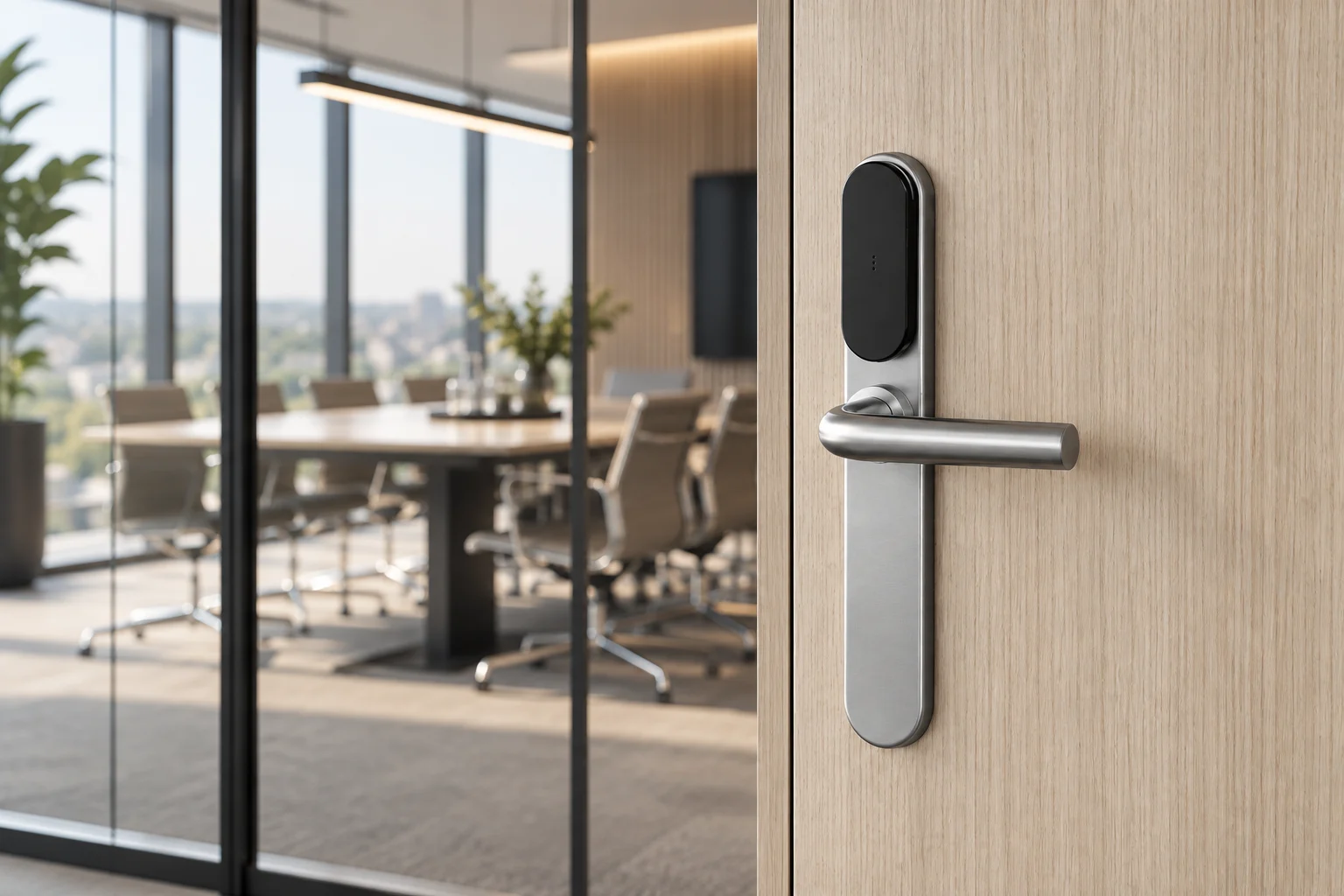
Access control is the technology that decides who can enter a building, room, or area: and who cannot. It replaces or supplements physical keys with electronic credentials: proximity cards, key fobs, PIN codes, biometric readers, or smartphone-based mobile access.
Businesses in Northern Ireland need access control for several practical reasons:
- Security: Restrict access to server rooms, stock areas, cash offices, and sensitive departments to authorised staff only
- Audit trail: Every door event is logged with a timestamp and user ID: invaluable after an incident or HR dispute
- Insurance compliance: Many commercial insurers require electronically controlled access for certain risk categories, including financial services, pharmacies, and data centres
- Remote management: Modern IP-based systems allow you to grant or revoke access from anywhere, instantly: no changing locks, no lost key replacement costs
- Integration: Access control events can trigger CCTV recording, interlock with intruder alarms, and feed into time-and-attendance systems
The cost of a break-in or internal theft in a Northern Ireland business far exceeds the cost of a properly designed access control system. According to PSNI crime statistics, commercial premises remain a significant target for opportunistic and organised theft, particularly in Belfast, Derry, and Newry.
Types of Access Control Systems: Which Is Right for Your Business?
1. Proximity Card and Key Fob Systems
The most common type in commercial NI premises. Staff carry a card or fob that communicates wirelessly with a reader mounted at each door. The reader checks the credential against the access database and releases the door if authorised.
Best for: Offices, warehouses, schools, multi-tenanted buildings
Products: Paxton Net2, Paxton10, HID readers
Pros: Cards are cheap to replace, easy to add and remove users, no PIN to forget
Cons: Cards can be lost, loaned, or cloned (though modern 13.56 MHz MIFARE cards with encrypted credentials significantly reduce this risk)
2. PIN Keypad Systems
Users enter a numeric code. Can be standalone (no network connection) or networked.
Best for: Low-traffic secondary doors, plant rooms, car parks
Pros: No card to carry, low hardware cost for simple applications
Cons: Codes get shared, not suitable for high-traffic or high-security doors, no individual audit trail if a shared code is used
3. Biometric Access Control
Fingerprint readers, facial recognition, or iris scanners verify the physical identity of the user rather than a credential they carry.
Best for: High-security environments, data centres, server rooms, research facilities
Pros: Cannot be shared, cloned, or lost
Cons: Higher hardware cost, slower throughput at high-traffic entrances, GDPR compliance requirements for biometric data (see Standards Explained section), employee acceptance issues
Important for Northern Ireland businesses: If you are considering biometric access control, you must comply with the UK GDPR (Data Protection Act 2018) and conduct a Data Protection Impact Assessment (DPIA) before implementation. Biometric data is classed as a special category under Article 9 of UK GDPR. Advanced Overwatch can advise on compliant deployment.
4. Mobile Access and Smart Credentials
Users present their smartphone at a Bluetooth or NFC reader. The credential is stored securely in the phone’s hardware secure element.
Best for: Modern commercial offices, co-working spaces, visitor management
Pros: No physical cards to manage, instant remote provisioning and revocation, integrates with building management apps
Cons: Requires users to have compatible smartphones, reliance on battery life, slightly higher reader cost
5. Standalone vs Networked Systems
| Feature | Standalone | Networked |
|---|---|---|
| Management | On-device only | Central software, any PC or mobile |
| Audit trail | Limited | Full, with user-level reporting |
| Remote access | No | Yes |
| Multi-door control | One reader per controller | Hundreds of doors from one platform |
| Scalability | Replace hardware to grow | Software licence expansion |
| Best for | Single door, small premises | Any multi-door or multi-site scenario |
For almost all Northern Ireland businesses with more than one door to secure, a networked system using software such as Paxton Net2 or Paxton10 is strongly recommended. Standalone systems become expensive to manage at scale and provide no central audit trail.
How Many Doors Do You Actually Need to Secure?
This is the question that determines your hardware budget more than any other. Start by categorising every door in your premises:
Tier 1: Must secure:
- Main building entrances and exits
- Server rooms and data storage areas
- Cash handling areas
- Medication storage (healthcare)
- Restricted areas specified by your insurer
Tier 2: Should consider:
- Internal office suites or departments
- Rooftop or plant room access
- Car park barriers
Tier 3: Optional:
- Staff canteen or welfare facilities
- Meeting rooms (visitor management rather than access control)
A typical mid-sized office in Belfast or Coleraine might have 4-8 doors in Tier 1. A warehouse complex with offices, a loading bay, and a secure compound might have 12-20 controlled points. Advanced Overwatch carries out a free site survey to map your entry points and recommend the right system size.
Integration with CCTV and Intruder Alarms
One of the most significant advantages of a modern IP-based access control system is integration with other security systems. Advanced Overwatch designs integrated systems where:
- Access control + CCTV: An access event (door opened, tailgate alarm, failed access attempt) triggers the closest camera to begin recording and flagging the clip for review. You can pull CCTV footage directly from an access event log without manually scrubbing through hours of recordings
- Access control + intruder alarm: Graded intruder alarm panels can interlock with access control so the alarm is automatically disarmed when the first authorised person enters in the morning and re-armed when the last person leaves: no codes to remember, no false alarms from staff forgetting to set the system
- Access control + visitor management: A visitor management screen at reception logs and badges visitors, with the access control system issuing a temporary credential valid only for the day and the permitted areas
This integration is only possible with a properly engineered system. Connecting three different brands that were never designed to work together is a common source of failures. Advanced Overwatch uses tested, compatible product combinations to avoid this.
Wired vs Wireless Access Control
Wired
Traditional access control is wired: each reader connects back to a controller via data cable, and the door hardware (electric strike, magnetic lock, or electromechanical lock) is powered over the same cable run.
Advantages: Reliable, no battery dependency, required for higher-security grades
Disadvantages: Cable runs can be disruptive in occupied premises, higher installation cost in complex buildings
Wireless
Modern wireless access control systems (such as Paxton10 with wireless readers) use encrypted radio communication. Readers are battery-powered and retrofit onto existing door hardware.
Advantages: Much lower disruption during installation, ideal for historic buildings or listed properties common in NI town centres, faster to deploy
Disadvantages: Battery replacement required (typically annually), slightly higher reader unit cost, not suitable for all door types
For a new build or full fit-out in Northern Ireland, wired is typically the correct specification. For a retrofit into an occupied, traditional building: a listed office in Derry’s city centre, a converted farmhouse turned business premises, or an older school: wireless is often the better choice.
Grading and Compliance Requirements
SSAIB Certification: Why It Matters
Your access control system should be installed by an SSAIB certificated company. The SSAIB independently assesses security installers against British Standards and European norms. Using an SSAIB certificated installer:
- Satisfies most commercial insurer requirements
- Provides a recognised standard for police-response connected systems
- Means the system is designed to the relevant BS EN standards
- Gives you independent recourse if workmanship is disputed
Advanced Overwatch is SSAIB certificated (NIRE127) specifically for Intruder Alarm Systems, Visual Surveillance Systems (VSS) and Access Control Systems.
Relevant Standards
Access control systems for UK and NI commercial premises are governed by:
- BS EN 60839-11-1:2013: System and components requirements for electronic access control
- BS EN 60839-11-2:2015: Application guidelines for electronic access control
- PD 6662:2017: The UK scheme for applying European standards for intrusion and hold-up alarm systems (relevant where access control is integrated with a graded alarm)
For premises requiring higher security grades (Grade 3 or 4 under PD 6662, typically financial institutions, pharmacies, or high-value commercial premises), access control specification must be aligned with the alarm grade: this is something Advanced Overwatch routinely handles.
Access Control for Different Sectors in Northern Ireland
Commercial Offices (Belfast, Derry, Lisburn)
Networked proximity card system securing the main entrance, server room, and any director or finance areas. Integration with intercom and CCTV at reception. Typical system: Paxton Net2 or Paxton10, 4-12 doors.
Manufacturing and Warehouses (Antrim, Newry, Craigavon Industrial Areas)
Readers rated IP65 or higher for dusty or wet environments. Vehicle gate control integrated with number plate recognition. Access zoning to restrict fork lift operators to warehouse only, visitors to reception.
Healthcare (Hospitals, Clinics, Care Homes)
Strict zoning to restrict medication rooms, records storage, and plant rooms. Biometric readers for pharmacy areas where appropriate, with full GDPR compliance. Interlock with nurse call and alarm systems.
Education (Schools, Colleges, Universities in NI)
Access control is increasingly a requirement for schools across Northern Ireland. The Department of Education (NI) guidance on school security recommends controlled access at all entrances. Systems must manage contractor access, prevent unauthorised exit by vulnerable pupils, and log all visitor access. The Protection of Freedoms Act 2012 applies to biometric use in schools: parental consent is required before any biometric data is taken from a child under 18.
Retail (Belfast, Omagh, Ballymena, Newry)
Back-of-house access control securing stockrooms, cash offices, and staff areas separate from the customer-facing shop floor. Often integrated with CCTV covering till areas.
What Does Access Control Installation Cost in Northern Ireland?
Access control pricing depends on the number of doors, the credential technology, and whether integration with other systems is included. The main factors are:
- The number of doors and readers
- Credential type (keypad, proximity card, mobile or biometric)
- Standalone or networked system, and software licensing
- Door hardware (electric strike, magnetic lock or electromechanical lock)
- Wired cabling or wireless retrofit readers
- Integration with CCTV, intruder alarms or visitor management
We give a clear written quote after a free site survey, covering hardware, labour, software licensing and commissioning. Annual maintenance contracts (required for SSAIB compliance) depend on the size of the system and are set out in the quote.
The cheapest quote is rarely the right choice for access control. A system that fails, cannot be expanded, or uses proprietary cards that lock you into one supplier will cost significantly more over its lifetime. Advanced Overwatch uses open-standard platforms and provides full system documentation so you are never locked in.
How to Get Started: Free Site Survey
If you are ready to review your access control requirements, the first step is a free, no-obligation site survey. Advanced Overwatch will assess your premises, identify every entry point, review your existing security infrastructure, and provide a written specification and quotation.
We cover all of Northern Ireland: from our base in Coleraine we serve Belfast, Derry/Londonderry, Ballymena, Magherafelt, Omagh, Newry, Lisburn, Bangor, and everywhere in between.
Call us, email us, or fill in the contact form on our contact page
Advanced Overwatch is an SSAIB certificated security installer (NIRE127). We are certified to ISO 45001 for occupational health and safety, and to ISO 9001, ISO 14001 and ISO 27001 for quality, environmental management and information security. All access control systems are designed and installed to BS EN 60839-11-1 and BS EN 60839-11-2.
Related Questions
Can I integrate my access control system with my existing CCTV?
Yes, if both systems support open integration protocols (most modern IP-based systems do). Integration means access events (door opened, failed attempt, tailgate detected) can automatically trigger the nearest camera to record and tag the clip, making incident review fast and accurate. Advanced Overwatch designs integrated access control and CCTV systems as standard. If your existing CCTV is older analogue equipment, it may need to be upgraded or supplemented before full integration is possible. During a site survey we will assess what your current CCTV can support and advise accordingly: the goal is always to maximise the value of your existing investment before recommending replacements.
What is the difference between a standalone and networked access control system?
A standalone system stores access permissions on the reader or controller itself and is managed on-site with no central software. A networked system connects all readers to central management software, allowing you to add and remove users, view real-time door status, generate reports, and manage access from any authorised PC or mobile device. For any premises with more than one controlled door, or any business that needs an audit trail, networked is the correct choice. Standalone systems get hard to manage as you grow: 20 readers reprogrammed by hand every time someone leaves. Networked systems handle this in seconds from a single screen.
Does access control require regular maintenance?
Yes. An SSAIB-compliant access control system requires at least annual preventive maintenance: testing door hardware, checking reader performance, reviewing firmware, testing battery backup, and verifying the audit log is functioning correctly. Maintenance also keeps the system eligible for insurance purposes. Advanced Overwatch offers maintenance contracts across Northern Ireland that cover access control, CCTV, intruder alarms, and fire alarms under a single agreement: simplifying your compliance obligations and providing a single point of contact for any issues.
Standards Explained
BS EN 60839-11-1:2013 (Electronic Access Control Systems, System and Components Requirements)
This is the core British and European standard for electronic access control systems. It defines the performance requirements for the hardware components: readers, controllers, locking devices: and sets out how systems must behave under normal and fault conditions. Any properly specified commercial access control system in the UK should be designed to meet this standard.
BS EN 60839-11-2:2015 (Electronic Access Control Systems, Application Guidelines)
The companion standard to BS EN 60839-11-1, this document provides practical guidance for system designers and installers on how to apply the component requirements to real-world installations. It covers topics like power supply resilience, cable specifications, network architecture, and how to handle door types. Installers who follow this standard will produce a more reliable, maintainable system.
PD 6662:2017 (Scheme for the Application of European Standards for Intrusion and Hold-up Alarm Systems) PD 6662 is the UK national scheme that translates the European intrusion alarm standards (the EN 50131 series) into a practical framework for specifying and installing graded alarm systems in the UK. When access control is integrated with an intruder alarm, the grade of the alarm system can influence the access control specification: particularly for Grade 3 or Grade 4 systems required in high-risk premises. SSAIB certificated installers work to PD 6662 as standard.
UK GDPR / Data Protection Act 2018 (Biometric Data)
Biometric data: fingerprints, facial geometry, iris patterns: is classified as “special category personal data” under Article 9 of the UK General Data Protection Regulation (UK GDPR), implemented through the Data Protection Act 2018. Before deploying biometric access control, businesses must have a lawful basis under Article 9(2), typically explicit consent or substantial public interest. A Data Protection Impact Assessment (DPIA) is required. The Information Commissioner’s Office (ICO) has published specific guidance on biometric recognition systems. Any installer recommending biometric access control should be familiar with these requirements: Advanced Overwatch advises clients on compliant deployment as part of the design process.
Protection of Freedoms Act 2012 (Biometric Data in Schools)
This legislation specifically governs the collection and use of biometric data from children under 18 in schools in England, Wales, and Northern Ireland. Schools must obtain written consent from a parent or guardian before taking any biometric data. Children aged 18 or over can consent themselves. Schools must also allow children to use an alternative non-biometric method if they or their parents object. Any school in Northern Ireland considering fingerprint-based access control must comply fully with this Act.